
The Place With All The Afterlife References: A Long Weekend in Valhalla Provincial Park
Maybe I’m getting old. A few years back, I definitely would’ve gone for it, urging myself over the chasm with a tremor in my hands and a platitude on my lips. Maybe “fortune favours the bold,” or, “if you want the biscuit, you’ve gotta risk it.” As it was, on that day in July, I felt no need to flirt with death.
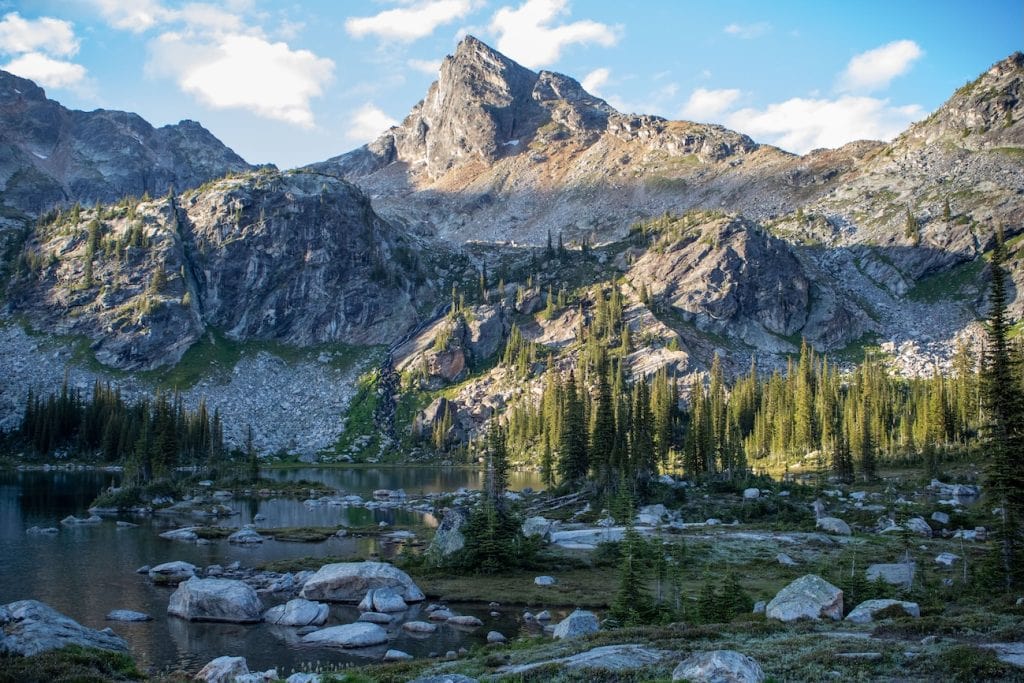
Valhalla Provincial Park is one of those overlooked gems in British Columbia’s Selkirk Mountains. For reasons I cannot comprehend – probably their proximity to the oversexualized Rockies – the Selkirks contain a small network of provincial parks neither overrun nor pacified. The hiking out there is still pretty raw, and those doing the hiking tend to be Western Canadian, belting down for a long weekend of mild discomfort and ecstatic views. Many – perhaps most – end up at Lucifer Peak.
You gain about 1,000 metres climbing this monster, either a full day’s hike from the nearest trailhead, or a half-day scramble from the nearest campsite, all trails approaching from the south. Because to the north, these 1,000 metres drop off Lucifer like the dry face of Hoover Dam, sheer, but for a gentle outward curve. One becomes aware of this drop long before peeking over the edge, an atavistic terror rising in the chest as one trudges up the final few hundred metres of trail.
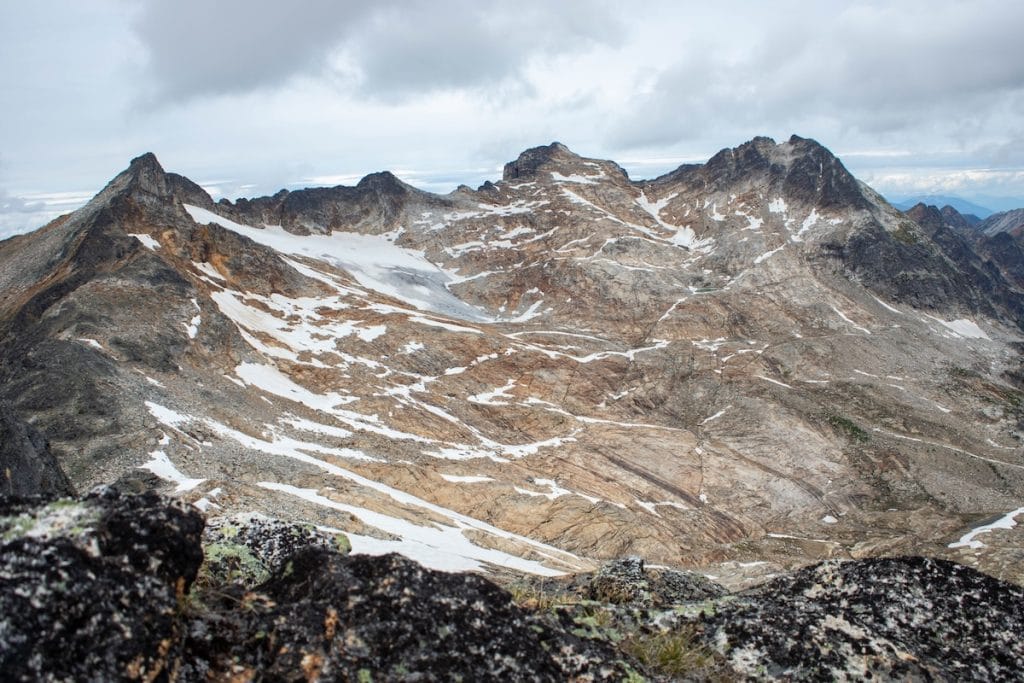
To the north of Lucifer, down the death drop, is a great bowl the size of a small city, inside which ice and snow have evidently sloshed for millennia. Most had melted when I got there, the bare rock beneath looking somewhat embarrassed, like earthworms exposed by the lifting of deadwood. Everywhere, the scars of motion, dark mineral veins, and a reddish hue I couldn’t place.
The funny thing about this sudden drop is that it persists, in one continuous ridge, far to east and west, dipping and leaping in a string of mountains – the Devil’s Range – more or less approachable from the south, all of it terminating in this sudden drop. By some quirk of erosion, the drop cuts into Lucifer Peak, separating its absolute summit from the main trail by a chasm three metres wide and a couple of hundred metres deep. The true panoramic view of the Selkirk Mountains, then, resides on the far side, just beyond reach.

A boulder has, by the work of some sadistic being, lodged itself in this chasm, just large and textured enough to be climbed over. It can not, however, be walked over. It sits too high and too awkwardly for any hops, skips or jumps. One must trust a few footholds on its side and shimmy across while space beckons below. I decided, at a glance, that the view was just fine on my side of the chasm. don’t have as much ego invested in the mountains as I did in my twenties.
A young couple came to this chasm shortly after me, and one of them – a man most definitely in his twenties – decided for both that a crossing was necessary. It took some pawing of the boulder and a few false starts, but eventually he struck upon a winning strategy. First, he took off his backpack and poles and flung them over the gap. Then he began the shimmy, testing a few combinations until his stomach was balanced atop the boulder, allowing him to spin his legs, as on a turntable, to the far side, all the while looking straight down into oblivion.
His partner wasn’t impressed, nor remotely game. She volunteered to wait on this side of the chasm, yielding to him the panoramic glories of the absolute peak a few dozen metres on, but he badgered and guilted and chastised her onto the boulder, insisting that it was “fine,” and “easy,” that she should “just do it,” and “come on!” This got her as far as the belly-on-the-boulder position, looking straight down, and then she froze in panic.
I can’t remember how long she was stuck there. It must only have been a few minutes, but her pleading and his bullying occupy a good chunk of my memory from that hike. The holds were good, and the gap was manageable, but her life was in her hands, and those hands were shaking when finally she got across. Up they went, out of sight, and I caught my breath.
Ultralight
Valhalla Provincial Park is deliciously undeveloped. No cabins or resorts penetrate its borders; all campgrounds are backcountry and first-come, first-served, and not a finger has been lifted to maintain the old logging roads linking its trailheads to the outside world. Bring a vehicle with high clearance and all-wheel drive, or be prepared to park early and walk.
That’s what we did. From Slocan – where I bought the best latte of my goddamn life – we drove our 2023 Ioniq 5 up Little Slocan Road North until asphalt became dirt, then swung right into the maze of logging roads when Google Maps told me to. Gwillim Lake Trailhead was up there somewhere, and the fact of our low-clearance car meant it took two hours of cautious navigation to reach.
The final kilometre of driving before the trailhead – roughly marked by a steep incline – is almost impassable. We parked below, watching in horror as tall, sturdy trucks inched their way up and down this quagmire, consistently getting stuck, bottoming out, and sending messengers ahead to warn others of their coming. Up we walked, passing vehicles squished into the vegetation wherever there were a few extra feet, each makeshift parking spot representing the limit of someone’s nerve. Most were wrapped in chicken wire, held with zip ties and weighed down with sticks and stones, guarding undercarriages, and especially brake lines, from the chewing of porcupines.
The hike itself was surreal, a densely forested trail opening up six or seven times to mountain views so sublime they were almost cliché. I’d seen these views before, or views just like them, hanging on every living room wall in every Ontario home before about 2000. Same with homes in Nova Scotia and Prince Edward Island, generations of people pining for remote, mountainous places where one might forget the relentless encroachment of other human beings, or imagine in their private hearts that beyond the horizon was just more horizon.
The hikers who stopped by these periodic views probably grew up under the same paintings and posters that I did, enjoying the curious contradiction of novelty and nostalgia. The Selkirk Mountains – part of the Columbia Mountains – have a way of condescending to you, just as one might kneel over an ant and boom out, “hello there, tiny, simple, stupid little creature.”
Gwillim Lake Campground is one of Valhalla’s finest backcountry oases, a mountainside crater – the technical term is “cirque” – gouged out by melting glaciers, however many thousands of years ago. Now it’s a gigantic bird bath, inside which water, soil and wildflowers have accumulated. People, too, pitching tents on a precious few wooden platforms, the rest finding dry, level ground among the wildflowers, everyone making discreet visits to the campgrounds’ pit toilets, erected like watchtowers to east and west.
And above all was Lucifer Peak, another half-day up. Gwillim Lake was our staging area, where one might filter water, cook dehydrated meals, sleep and marvel at the mountains above and below. Those above belonged to the Devil’s Range, and were named accordingly – Black Prince Mountain, Dark Prince Peak, Devil’s Dome, Satan Peak, Devil’s Spire, Devil’s Couch – with only a few off the beaten path, like Mount Mephistopheles (a Germanic demon) and Banshee Peak (an Irish spirit heralding death). Across the way, to the south, was a cluster of glistening white peaks named explicitly after Norse mythology – Midgard Peak, Asgard Peak, Gladsheim Peak, Nisleheim Peak. Valhalla Provincial Park has a theme, or, if you like, a vibe, summed up beautifully by that boulder atop Lucifer Peak, bridging worlds over a drop of death.
Gwillim Lake Campground is cool during the day, even in late July, and by night it yields to winds occasionally strong and always cold. The transition from one to another is marked by mosquitoes, ushering everyone into tents and sleeping bags in ten minutes or fewer, a social, sunny camp reduced hastily to a ghost town, populated with stars and a few billion bugs. Now and again, amid the buzzing and the wind, one would hear a loud wooden bang as someone lost hold of the heavy swinging doors of the pit toilets in the dark, and the resounding metallic clang of the bear boxes as people went in search of a midnight snack.
I adore camp life. The simplicity of eating and resting and staring and eating again suits me in places this wild and beautiful, and being a writer, the temptation is always there to sit on a boulder in the sun and scribble fiction and poetry in my notebook, and to chat with my fellow camp dwellers.
One fellow, overwhelmingly sincere, had come up with his four-month-pregnant wife and their one-year-old son, the little fella hardly walking in his puffy pants, jacket and boots. Their hikes were usually more extreme, he explained, but with their second child on the way, they compromised on something “more casual.” A couple in their late forties was chaperoning something like eight teenage girls, every one of whom was inexplicably enjoying herself, without a trace of complaint or of cell signal. The folks camped nearest us were decked in the absolute best gear for this kind of thing, ultralight backpacks and clothes and a tent, erected beautifully on a wooden platform with guy lines stretching neatly in every direction, while we languished in the mud, overpacked and modestly equipped.
The Mountain Goat Trail
The mornings are pretty special in Gwillim, golden hour light driving off the bugs, and a gentle breeze sweeping all fog off the nearest cliff. Everything is easy on the eyes up there, but I indulged in a little feng shui when setting up our tent, shamelessly aligning my flap with Lucifer to the north, and my wife’s with Gregorio Peak to the south, titans glistening in a caffeinated dawn, just beyond our drying boots and canisters of bear spray.
Gwillim Lake more or less marks the treeline. It’s about here that spruce and fir grow ancient without growing especially tall, and where alpine meadows begin to assert themselves. Immediately above Gwillim – in the next crater up, you might say – is an open landscape swooping gently up, up, up toward the Devil’s Range, so gently that boulders the size of houses stand upright here and there like tombstones, or dominos, frozen in the act of falling over. It’s the kind of natural architecture one might carve a few Scandinavian runes into, provided one had something to say.
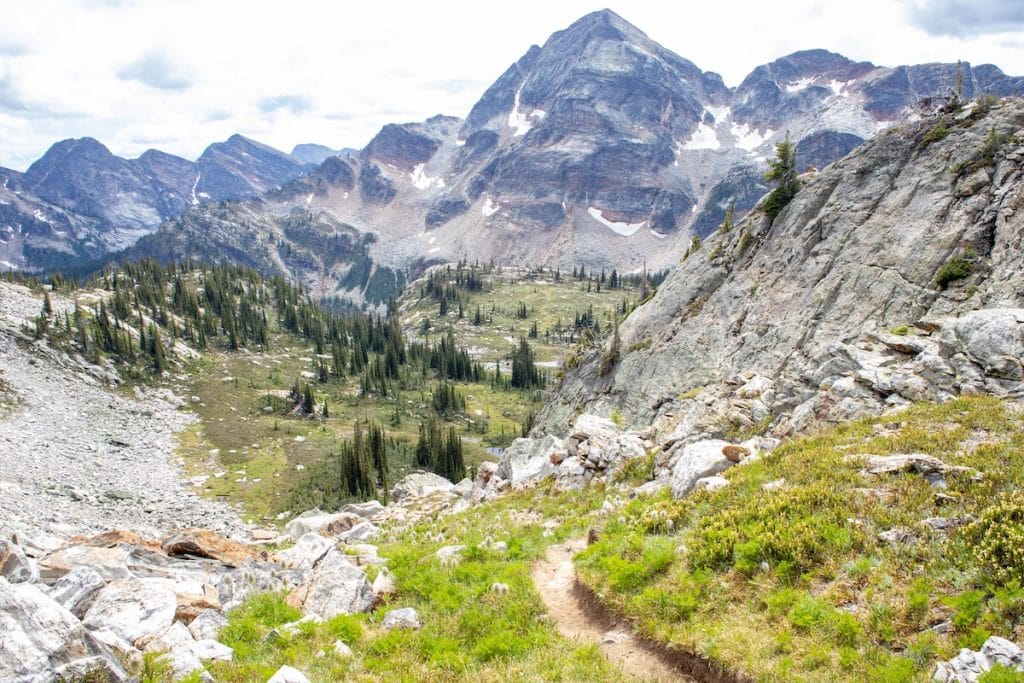
We ascended on a footpath at once well-worn and cryptic, plainly hammered into the mud by a hundred thousand boots over here, and lost in the confusion of shattered shale over there. This path narrowed splendidly until the navigable stones are big, awkward, and bordered tightly by space, plummeting down a few dozen or a hundred metres on either side. Lucifer Peak becomes indistinct at this angle – like we were looking up someone’s nose – while other summits on the Devil’s Range, Trident Peak and Mount Mephistopheles in particular, resolved into nations, declaring their independence in real time, every peak joined by slim bridges of rock, like children holding hands.
I remember dangling my legs over yet another precipice, staring at Mephistopheles across the void, and being struck by two things. First was a goat trail immediately beneath me, descending a dirty rope-and-harness cliff at right angles, marked by dung and hoofprints and not a single corpse. The second thing to strike – or arrive – was a whistle, bouncing off so many monolithic surfaces it would have been impossible to track. This sound puzzled us a few times that morning. Was it a baby goat, an alpine hawk, a hiker calling for help? I discovered a whistle on my backpack at that very moment, built cleverly into a clip by my left ear, and so I blew back, gratified by two return calls, and then confused silence. Definitely a bird. Probably a thrush.
We spent a long time up there, shivering in July, and humbled by the world beyond the death drop. I was, at that time, working on an article about ecosystem formation in the wake of melting glaciers. In places like Alaska and northwest British Columbia, the long mountain valleys emerging, naked and afraid, from beneath all that melting ice are being rapidly colonized by bugs, by trees, by lichens, and especially by salmon, charging into novel wetlands like sperm upon a womb. The great bowl of scarred rock to the north of Lucifer, in which a few packs of snow still clung, got me thinking along these lines. What, if anything, would impregnate the great bowl below as even these altitudes warmed up?
Opposite the infamous boulder, the Devil’s Range runs smoothly east, up and down, up and down, the sharp ridge threading through all. It had the appearance of so many rope bridges, as deceptive and as welcoming as a mirage. Hiking a few minutes in that direction is to appreciate the spectacular distances involved and the treachery inherent in such paths. That way lies many wedged boulders.
A long weekend was all we could afford, and we departed the ridge with just enough time for a hasty descent, a wolfish supper at Gwillim, and a bedtime preceding the bugs, but not before pointing in half a dozen directions, and scheming. Over there was Goat Range Provincial Park, and out yonder, Kokanee Glacier Provincial Park, between themselves and Valhalla, protecting a good chunk of the Selkirk Mountains. And of course, there was the rest of Valhalla, Asgard Peak taunting us to the south, Gimli Campground hiding somewhere beyond. It’s the kind of place you cannot leave without promising to come back, where those cheesy old posters on living room walls come readily to life. Hello there, tiny, simple, stupid little creature. Welcome.
Have you been? Leave us a comment below!