
Our First Backcountry Canoe Trip in Alberta: 3 Days in Lakeland Provincial Park
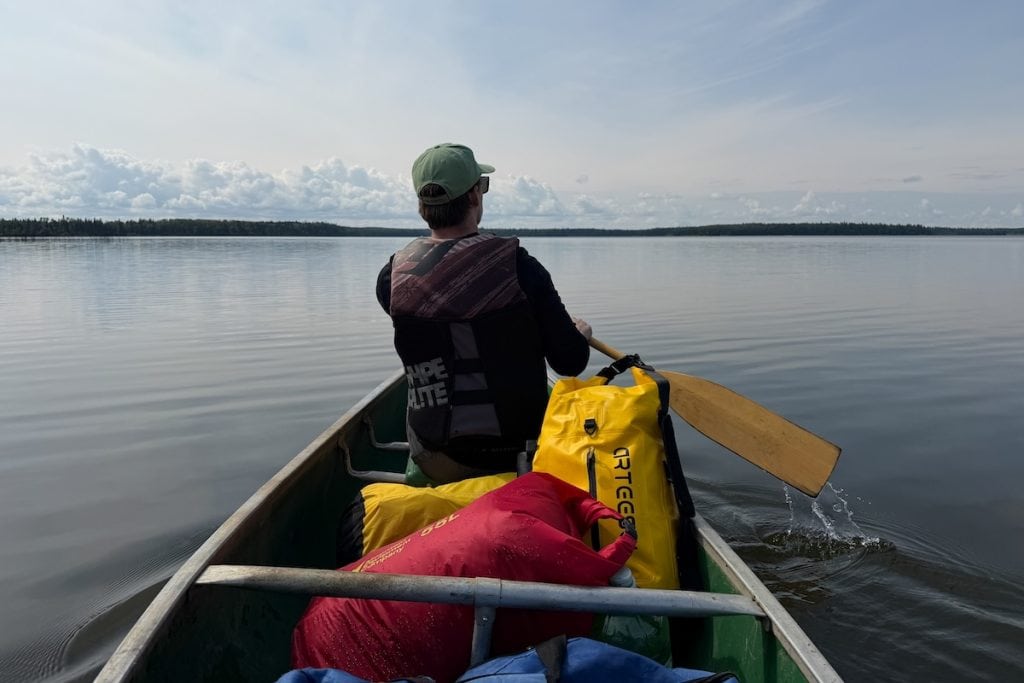
I’ve wanted to try a proper backcountry canoe trip for a while.
Not the kind where you paddle around a lake for a couple of hours and then pull your canoe up beside a campground with your vehicle nearby. I mean the real thing: pack everything you need into a canoe, paddle from lake to lake, carry the canoe and gear over portages, and spend a few nights somewhere you can’t simply drive to.
So when the opportunity came to spend three days canoeing Alberta’s only canoe circuit in Lakeland Provincial Park, I was excited… and a little nervous.
This was my first real backcountry canoe trip, and I had spent a ridiculous amount of time researching what we might need. Water purification tablets, dry bags, bear spray, first-aid supplies, camping stoves, sleeping gear, food, and approximately 47 other things that seemed like they might suddenly become essential once we were miles from the nearest road.
In the end, we didn’t need nearly as much as I thought we did. But we did learn a few things along the way.
And there were definitely moments when I wondered why I had voluntarily signed up to carry a canoe through the mud.
Day 1: Getting Into the Wilderness
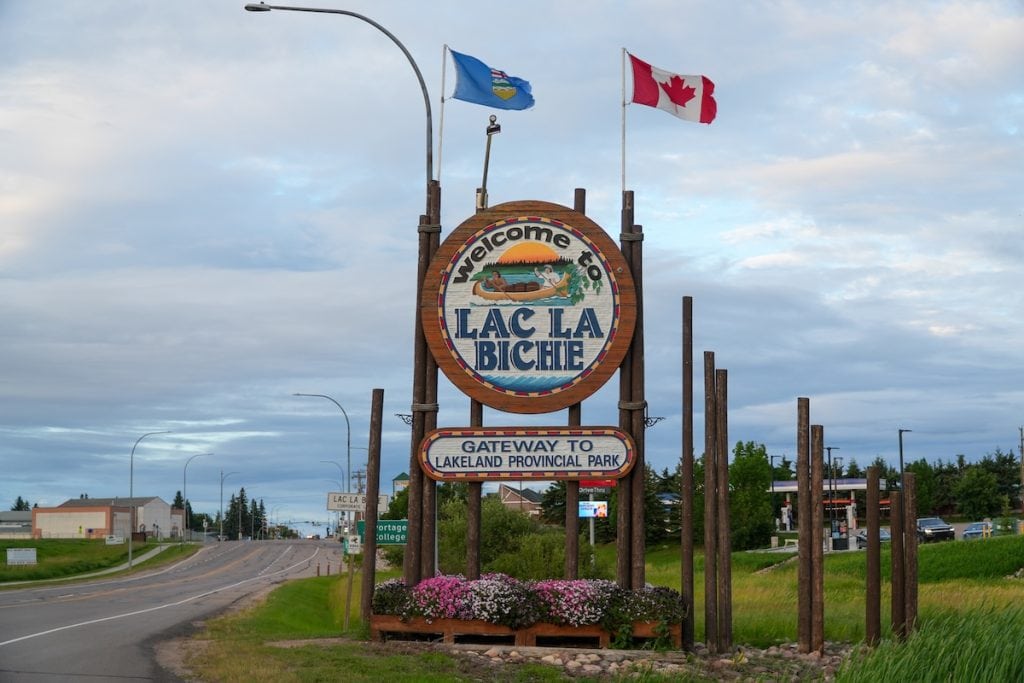
We arrived at the Jackson Lake Staging Area around 9 a.m., ready to begin our three-day adventure. It’s only a 30-minute drive from Lac La Biche, so I highly recommend spending the night and leaving when it suits you best.
Although it would be nice for a canoe adventure to start on a lake, this one starts with a 3 km portage.
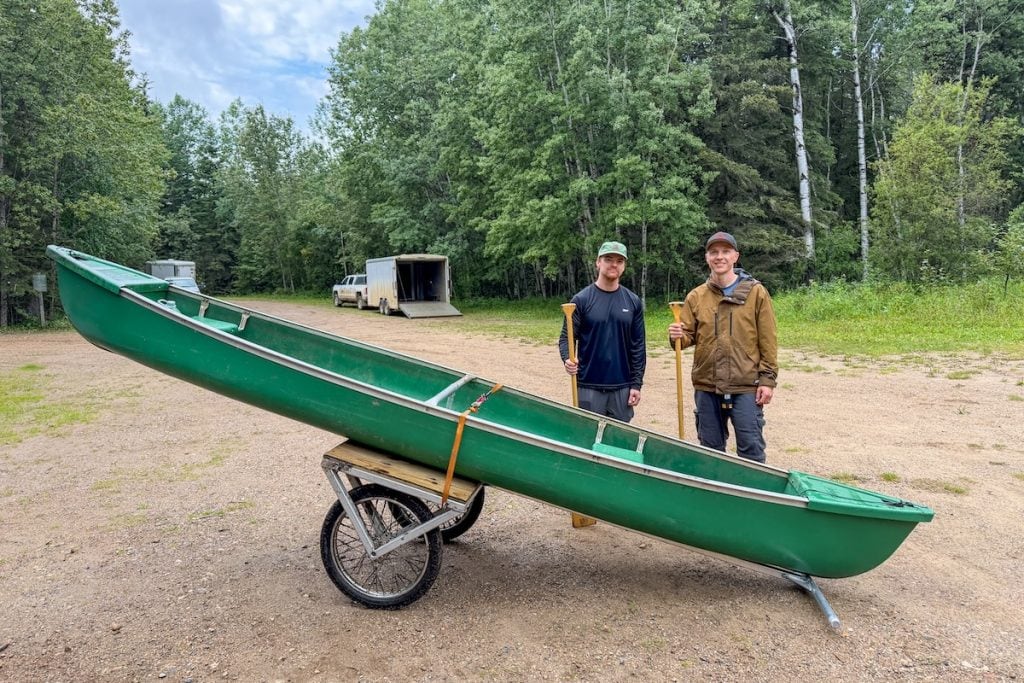
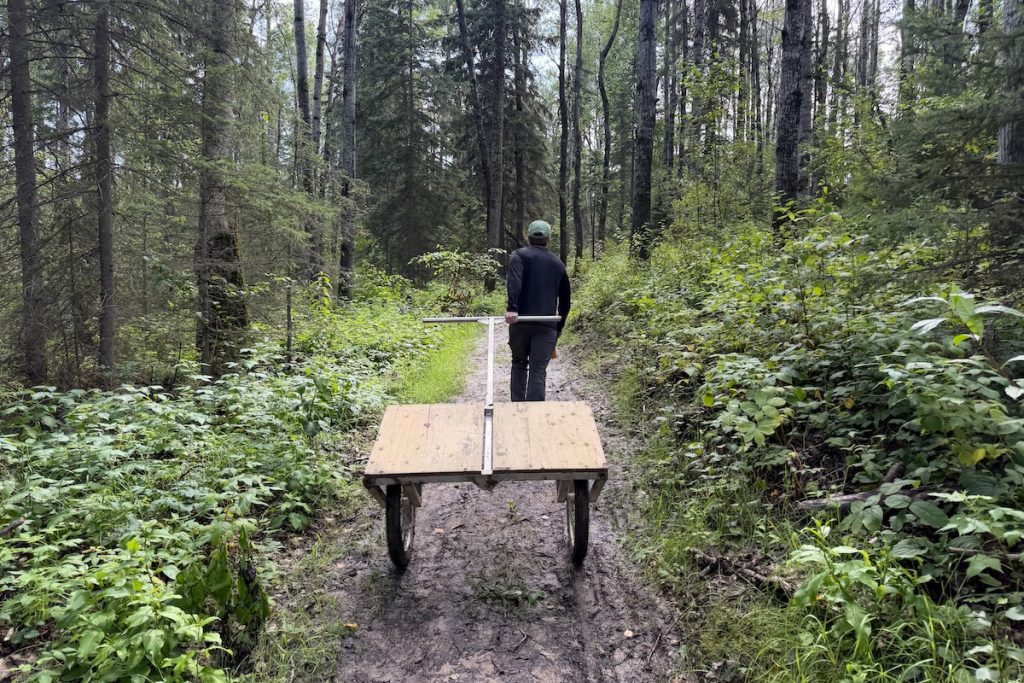
Before we could even launch, we had to get our canoe and gear roughly three kilometres down a trail to Jackson Lake. Thankfully, we had one of the many provided canoe carts, and the person who loaned us the canoe had also given us a ratchet strap.
We didn’t initially think much of the strap. Actually, I don’t think he did either. He just saw it in the back of his truck and asked us if we wanted it.
We would come to appreciate it very quickly.
We loaded our gear onto the cart, secured the canoe and started down the trail. The path wasn’t terrible, but there were puddles and muddy sections, and pulling a loaded canoe through the forest is considerably different from simply walking a three-kilometre trail. Sometimes, it would hit a puddle hard, and the canoe would almost slide off. This is where the ratchet strap came in handy.
The mosquitoes were also brutal.
Still, eventually the forest opened up, and we reached Jackson Lake. After all the preparation, this was the moment when the trip finally felt real. We loaded the canoe, pushed away from the dock and started paddling.
Almost immediately, the landscape changed our pace.
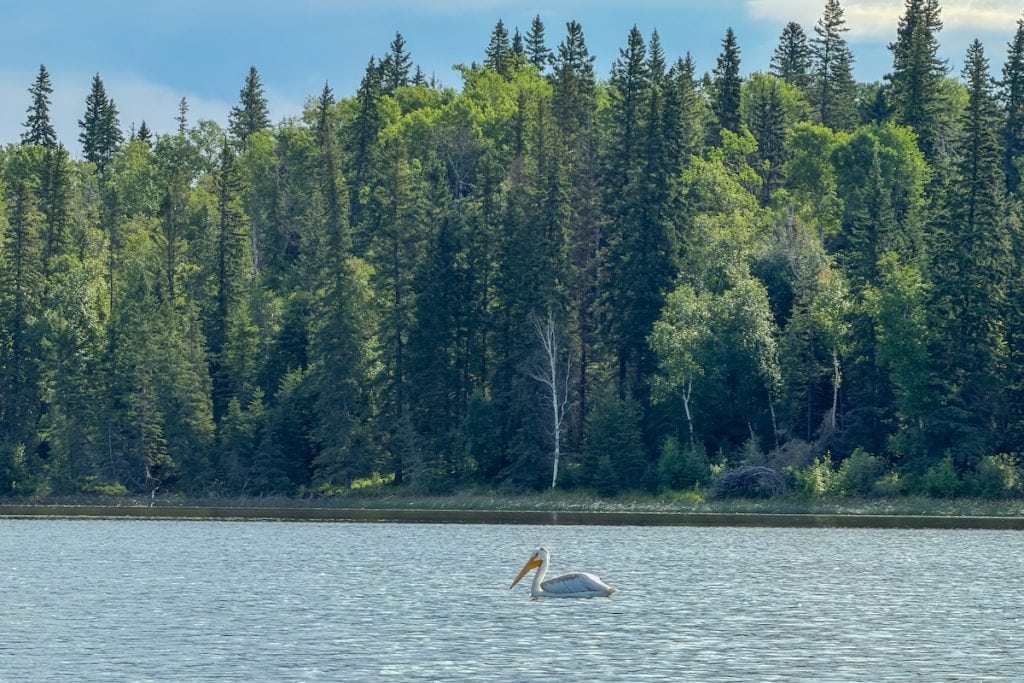
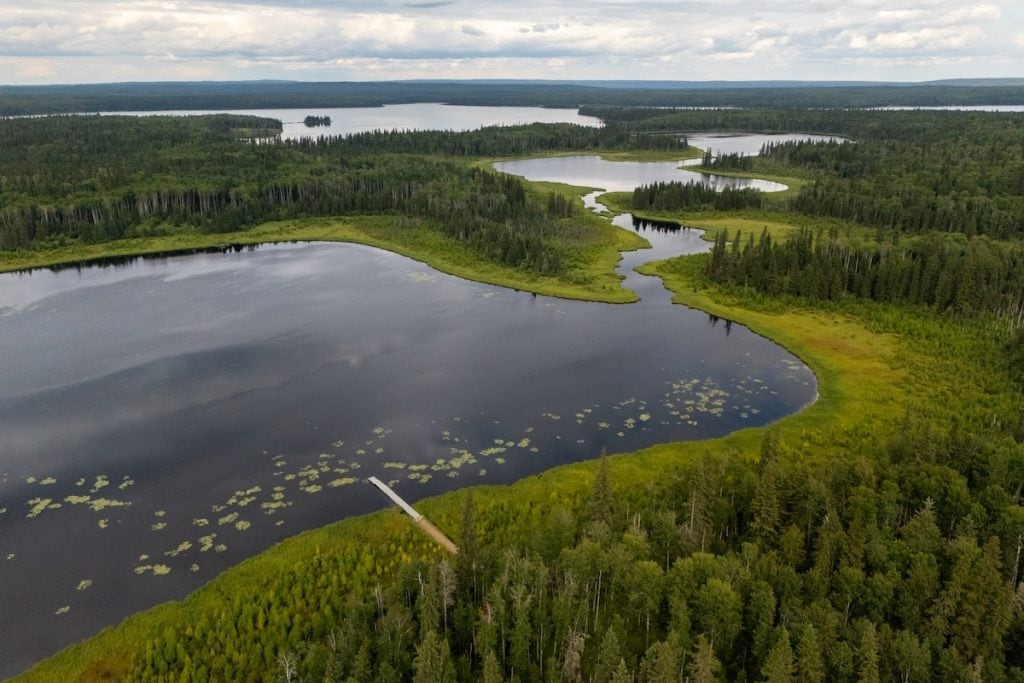
The water was incredibly calm, loons were calling across the lake, and we spotted a beaver lodge not far from the launch.
Then two military fighter jets flew overhead.
It was a pretty funny reminder that even though we felt like we’d escaped civilization, we weren’t exactly in the middle of nowhere. There is an Air Force base nearby, and the occasional aircraft is apparently part of the Lakeland Provincial Park experience.
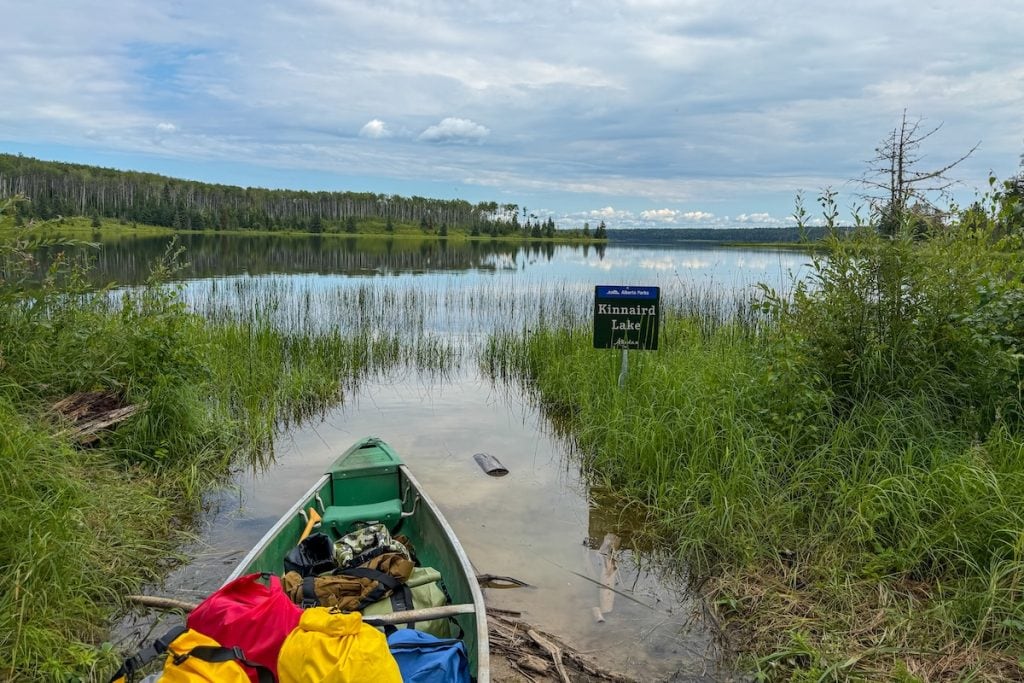
We continued through the narrow waterways toward Kinnaird Lake. The farther we paddled, the quieter everything became, and before long the outside world seemed to disappear.
That was exactly what we’d come for.
Kinnaird Island: Our First Night in the Backcountry
After a couple of hours of paddling, we reached Kinnaird Island, where we planned to spend our first night. We could have continued farther, but when we realized we could have the entire little island campsite to ourselves, the decision was pretty easy.
We were staying.
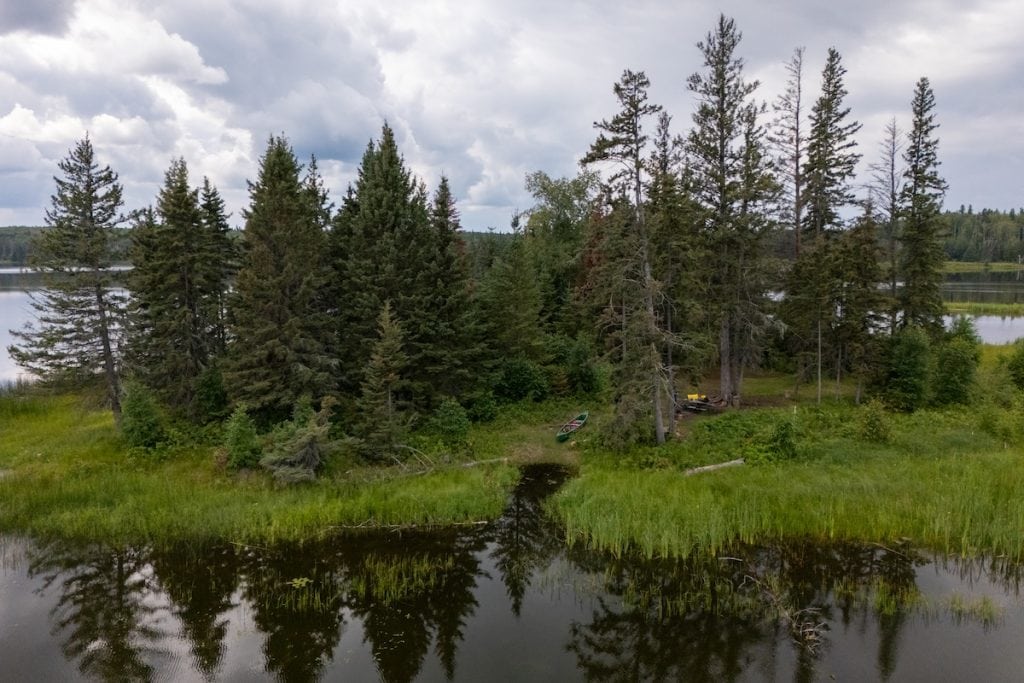
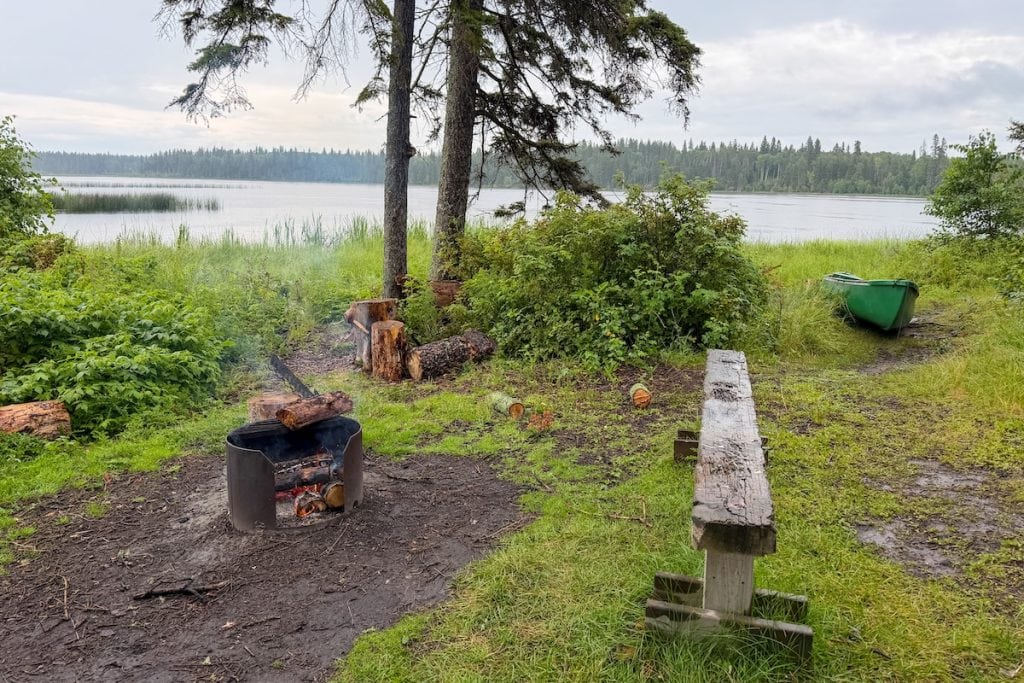
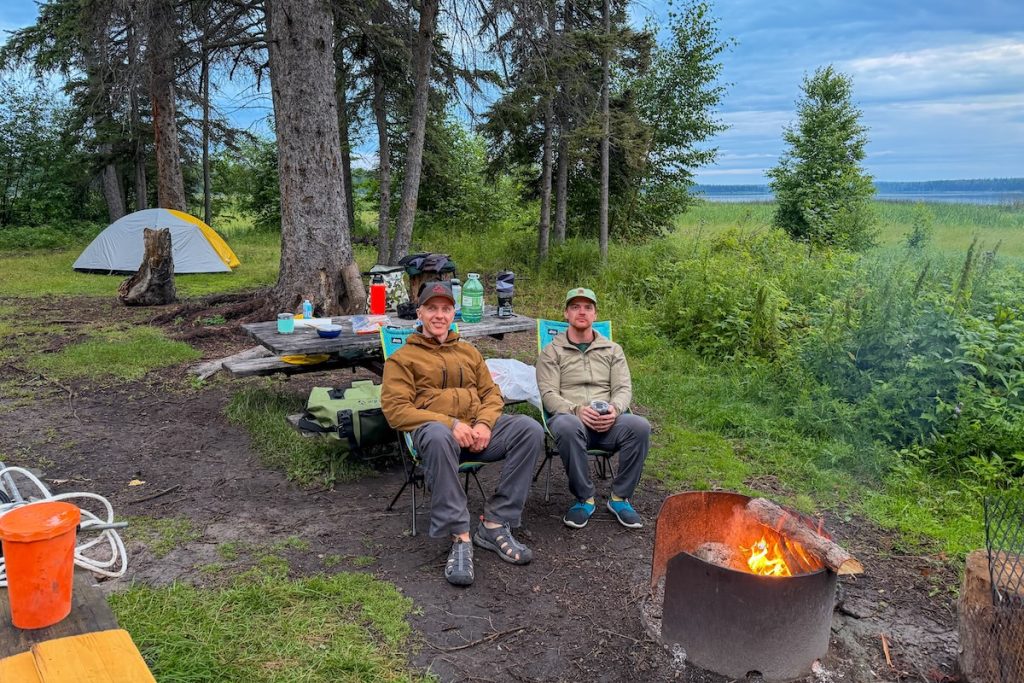
The island is small enough that you can explore much of it in just a few minutes, but that’s also part of its charm. There was a picnic table, a bear locker and a pit toilet, but otherwise it felt like we had our own little piece of the park. We set up the tent, organized our gear and settled into camp. We’d also brought camp chairs, and after spending the day paddling and hauling equipment, I was very happy we’d made room for them.
Eventually, rain arrived.
We hadn’t brought a tarp, but we discovered that a huge spruce tree provided surprisingly good shelter. We dragged our chairs underneath the branches and sat there while the rain came down around us. It wasn’t exactly the dry campsite experience I had imagined while researching camping gear, but honestly, it was pretty great.
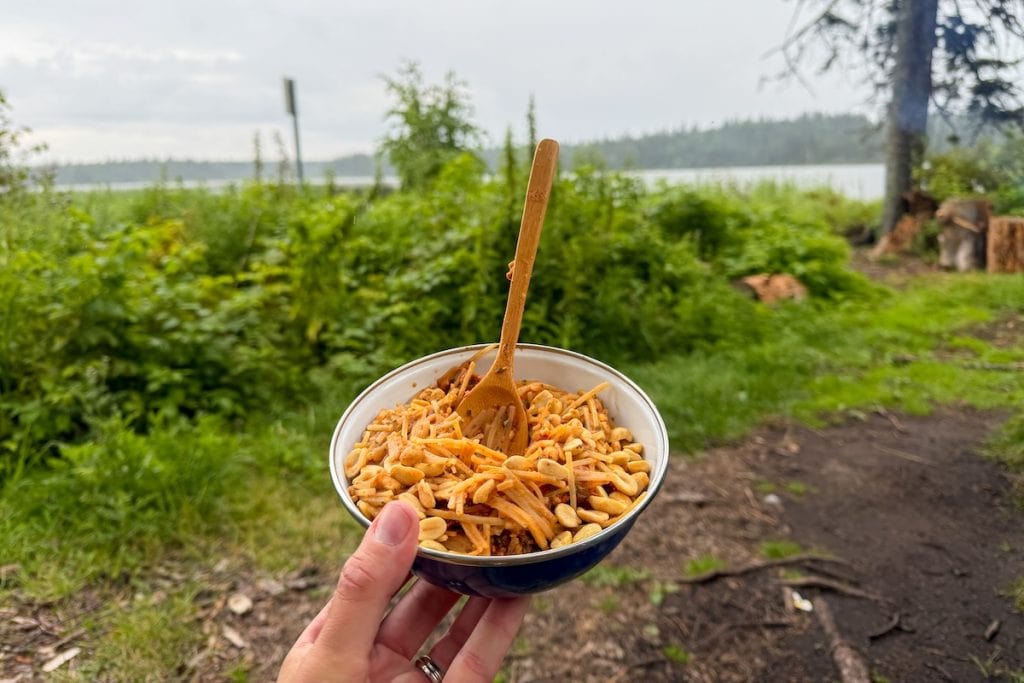
Eventually the rain passed. We made dinner, had a beer and settled into our first night in the backcountry.
Day 2: Blackett Lake and a Much Longer Portage Than Expected
The second morning started fairly slowly. We had a route to cover, but we weren’t exactly racing out of camp. We planned to continue toward Blackett Lake and eventually make our way to McGuffin Lake, where we’d spend our second (and last) night.
There are two ways to reach Blackett Lake from Kinnaird. The shorter option involves a portage into the northern portion of the lake, while the longer route takes you farther south and allows you to explore more of Blackett without taking that initial portage.
The southern route sounded much more appealing. The problem was time.
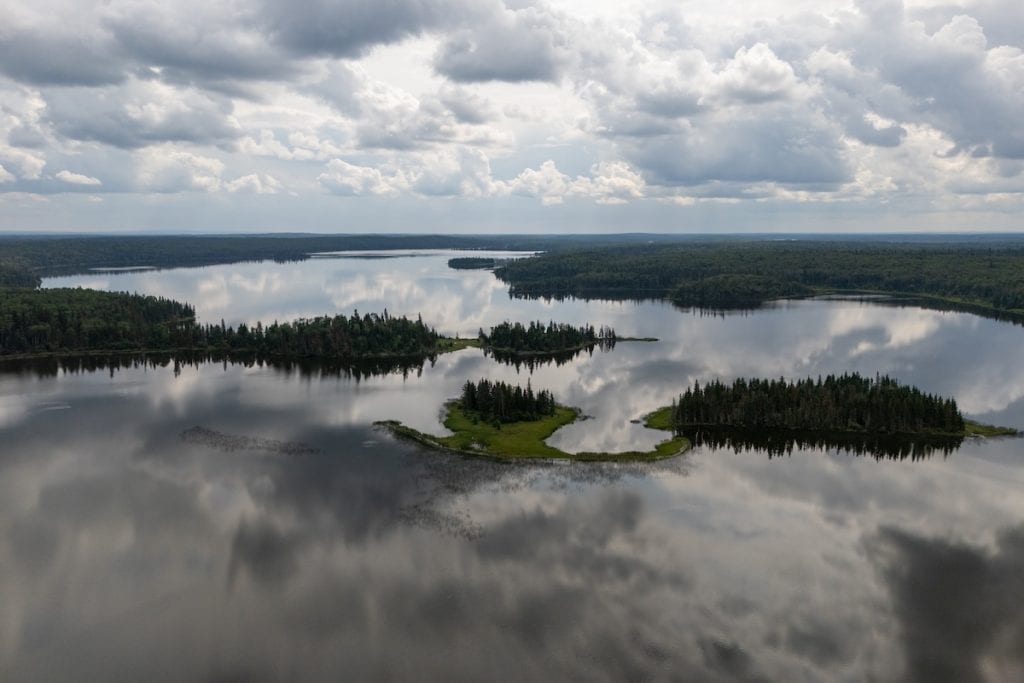
We wanted to reach McGuffin Lake that day, and taking the southern route would have added several hours of paddling before we even reached the longer portage into McGuffin. Since we’d already started the day relatively late, we decided the shorter northern route made more sense.
Looking back, I think we made the right decision.
If we return for three nights, though, I’d absolutely take the southern route. Having another night would have given us time to explore more of Blackett Lake and potentially camp on one of the islands rather than trying to fit everything into one long day.
The first portage was roughly 800 metres and, although it wasn’t particularly long, it was surprisingly hilly. Rain from the previous day had also left parts of the trail muddy, making the hills a little more challenging.
Still, it was manageable. We hauled the canoe and our gear through the forest and were back on the water in less than half an hour.
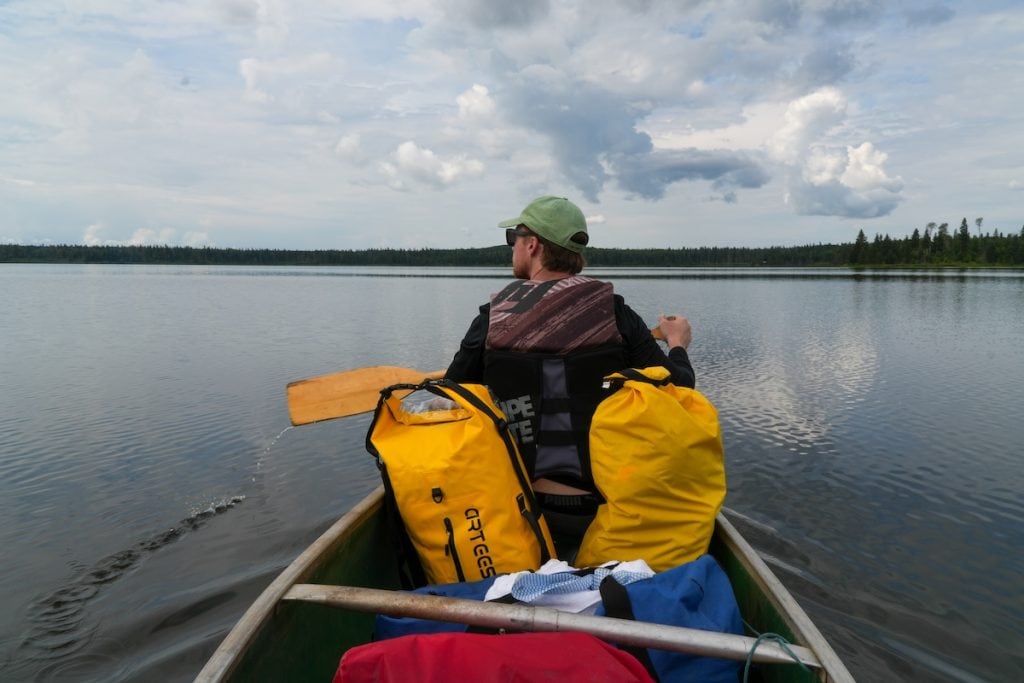
Blackett Lake was beautiful. Ducks were everywhere, loons were calling, and once again the water was remarkably calm.
Then we reached the portage into McGuffin Lake.
And that’s where we learned our biggest lesson of the trip.
The Canoe Cart Problem
The portage into McGuffin Lake is listed at approximately 1.6 kilometres, which sounded completely manageable considering the first portage was 3 km.
What we didn’t know was that there wasn’t a canoe cart waiting for us at the trailhead. So we walked the entire trail to retrieve one. Then we walked back to the canoe. We loaded everything up. And then we walked the entire trail again.
Our 1.6-kilometre portage had effectively turned into roughly 4.8 kilometres of walking.
With a canoe.
And camping gear.
On a muddy trail.
Let’s say that by the end of it, we had developed a much deeper appreciation for canoe carts.
We also encountered bear scat along the trail, which changed the mood a little. We put our bear spray somewhere we could actually reach it and started making a little more noise as we walked.
We never saw a bear, but knowing one had recently been on the trail definitely made us pay more attention to our surroundings. After all, one of the guys we met in the parking lot on the first morning told us that he saw four bears during his time in the provincial park.
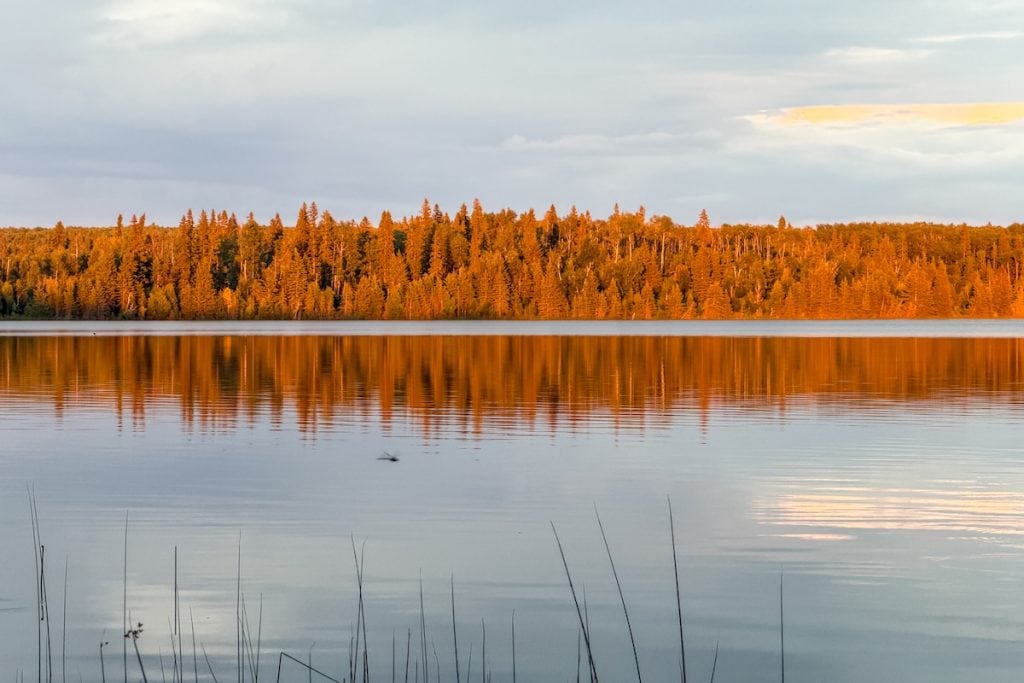
Eventually, we reached McGuffin Lake and, just like previous paddles, the water was glass-like, completely flat and reflecting the clouds from above.
McGuffin Lake and an Unexpected Piece of History
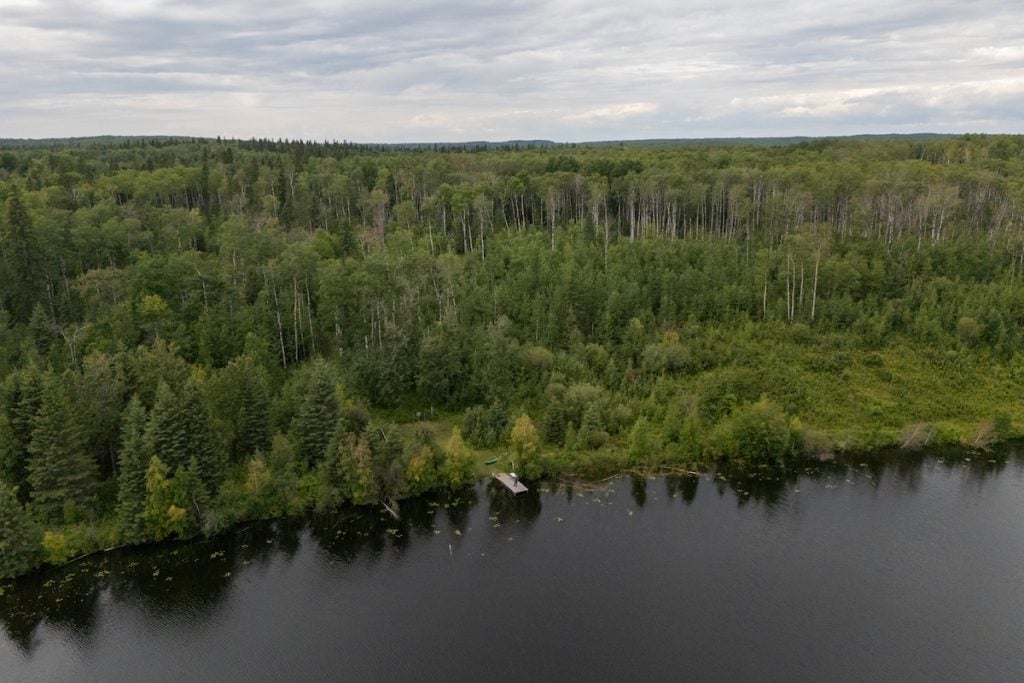
After the long portage, we loaded the canoe and continued toward the McGuffin Lake campground.
It felt different from Kinnaird Island. There were other campers around, and the site was accessible by quad, so it didn’t feel quite as isolated.
But the scenery was beautiful.
We also met another camper who had been exploring Lakeland Provincial Park for decades. He told us that he rarely saw people at the campground, which gave us a good sense of just how quiet the park can be.
Then we noticed something on the Lakeland Canoe Circuit map that we hadn’t really thought about before: a memorial cairn near the campground. A Parks and Wildlife officer who visited the site told us about the memorials in the area and the people they commemorate. One of them honours William Chester McGuffin, the man after whom McGuffin Lake is named.
McGuffin was killed during the Second World War after completing more than 50 missions. He was only 29 years old. We hadn’t come to Lakeland looking for history. We had come to paddle. But that’s one of the things I enjoyed most about the trip. You never quite know what you’re going to discover.
We walked out to the memorial and spent some time taking it in before returning to camp.
A Campfire, the Milky Way and the Perseid Meteor Shower
Back at camp, we had another problem.
The previous day’s rain had left a lot of the firewood wet, and we hadn’t brought an axe or hatchet. That’s one piece of gear I’d probably change next time.
Thankfully, some of the other campers had larger knives and helped get into the drier wood underneath the spruce and pine trees. Eventually, we managed to get a fire going.
Dinner was simple. We had freeze-dried meals, snacks and food that required very little preparation or cleanup. We had also brought two beers and ingredients for s’mores, because apparently our definition of “backcountry minimalism” has limits.
After a full day of paddling and portaging, sitting in a camp chair beside the fire, listening to loons and eating a s’more felt pretty luxurious.
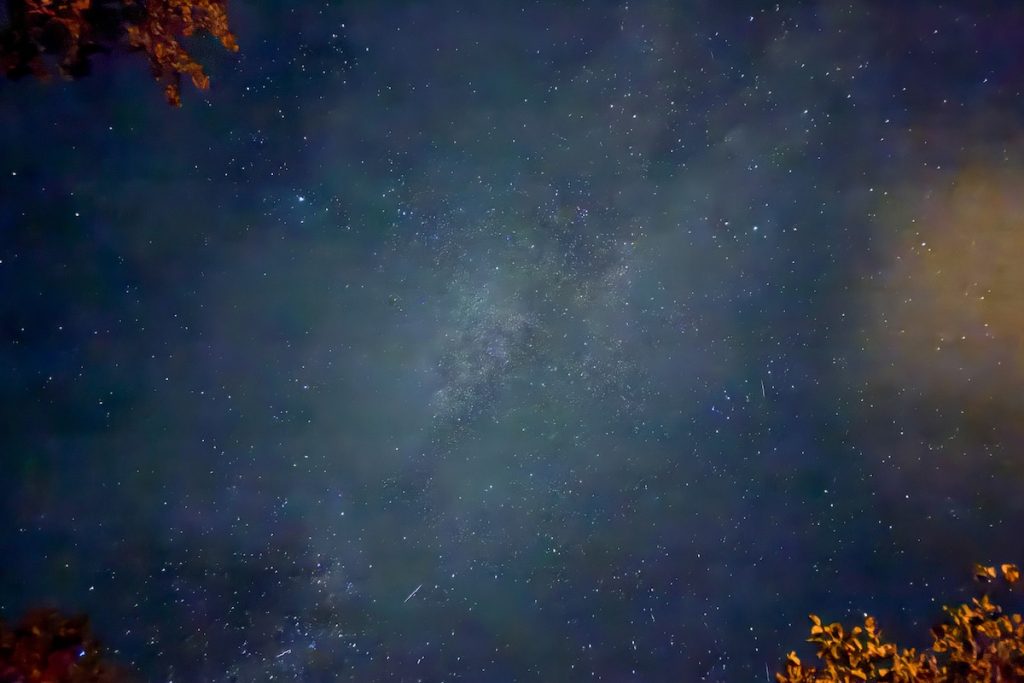
Then the clouds started clearing, the sky opened up, and we could see the Milky Way.
Because we happened to be there during the Perseid meteor shower, we also started seeing shooting stars. I saw one. My nephew saw several more, while our neighbours seemed to be seeing five or six at a time.
We probably should have stayed up longer. But after a full day of paddling and portaging, exhaustion eventually won. We went to bed around midnight.
The Northern Lights never appeared—the clouds rolled back in before we got the chance—but it didn’t really matter. The Milky Way and meteor shower had already given us one of those nights that makes all the effort of getting into the backcountry worthwhile.
Day 3: Racing the Weather on Jackson Lake
Before going to sleep, our fellow campers warned us that a storm was expected the following day. More importantly, they told us that Jackson Lake can become challenging when the wind picks up. An Alberta Parks staff member had given us the same warning when we first arrived.
That convinced us to change our plans.
Rather than having a leisurely breakfast, we got up early, grabbed a protein bar and aimed to be on the water around 8 a.m.
It turned out to be one of the best decisions we made.
Jackson Lake was beautifully calm when we reached it. We paddled through the sheltered southern section and a narrow marshy inlet before reaching the open lake. The lake was still calm, so we started crossing. Then the clouds darkened, and the wind began to pick up. Fortunately, we’d already completed the most exposed portion of the crossing before conditions deteriorated. Once we reached the narrower section of the route, the wind wasn’t nearly as concerning.
Eventually, rain started falling. We spent the final 30 to 60 minutes paddling through it, but we’d packed almost all of our important equipment into dry bags, so there wasn’t much to worry about. Also, considering this was the first time it rained while we were canoeing, we got pretty lucky.
And then we reached the dock.
The Final 3-Kilometre Portage
There was one last obstacle between us and the car: the three-kilometre hike back to the staging area.
Thankfully, there was a canoe cart waiting for us.
After our experience at McGuffin, seeing that cart was a beautiful sight. We loaded everything up, secured the canoe with our now-beloved ratchet strap and started down the trail. Unfortunately, the rain had transformed portions of the path into thick, ankle-deep mud. This was easily the toughest part of the trip.
Three days of paddling had caught up with us. My arms and shoulders were sore, our legs were tired, and every muddy puddle seemed determined to make the final kilometre take just a little longer.
But there was one thing keeping us going:
A hotel room.
About an hour later, we finally reached the Jackson Lake Staging Area. We unloaded everything, put the gear in the car and gave each other a ceremonial high-five.
We had made it.
Three days. Two nights. Dozens of kilometres of paddling. Several portages. A ridiculous amount of mud. Rain, mosquitoes (actually, not that bad on the lakes), loons, meteor showers and enough sore muscles to remind us that we’d actually done something.
And yes, that hotel shower may have been one of the best showers of my life.
The hot tub wasn’t bad either.
What We Learned From Our First Canoe Trip
Going into this trip, I spent a lot of time researching gear and talking to other creators who do more paddling. What water filter should I bring? Did I need a tarp? What kind of dry bags? What first aid kit? How much water? Which stove? Did I need a multitool? What about a power bank?
By the time we left, I probably could have opened a small outdoor store.
But after actually doing the trip, I realized that the most important things weren’t necessarily the things I’d spent the most time researching.
The ratchet strap was one of the simplest and most useful pieces of equipment we brought. A canoe cart can make a huge difference on a long portage, but you shouldn’t assume one will always be waiting where you need it. And if you’re crossing Jackson Lake, getting an early start can make a significant difference if the wind picks up later in the day.
Keeping our important equipment dry was another big one. We got caught in rain on the final morning, but our electronics, clothing and other important gear were protected because we’d packed them properly.
And perhaps the biggest lesson was to give yourself more time than you think you need.
Our two-night trip worked, but if we did it again, I’d probably take three nights. I’d explore more of southern Blackett Lake, spend another night in the park and slow the whole experience down.
Because that’s ultimately what I think backcountry canoe camping is supposed to be about.
Not rushing or watching the clock. Not worrying about whether you’ve seen every lake.
Just paddling, exploring, sitting beside a fire, listening to loons and looking at the stars. And occasionally wondering how the heck the first portage can leave you with no canoe carts at the endpoint. I mean, if someone makes it to the lake, that means they have taken a cart, and therefore, it would remain there until someone else takes it back. Weird, but anyways…
Would We Do It Again?
Absolutely.
Before this trip, I wasn’t sure whether backcountry canoe camping was going to be something I’d love or something I’d try once and never do again.
Now I know, and I’d love to go again. However, I don’t think I’m ready to bring the toddlers, so it might be some time before I’m able to spend a few days canoeing.
As for Lakeland Provincial Park, I’m so happy to have explored it. It is now one of my favourite provincial parks in Alberta. Next time, I’d absolutely extend the trip to three nights, though and explore the Southern islands of Blackett Lake. Everything is cooler when you spend the night on an island.
Lakeland Provincial Park turned out to be exactly the kind of Alberta adventure I’d been looking for: challenging enough to feel like an accomplishment, accessible enough for a first-time backcountry paddler, and beautiful enough that the muddy portages are eventually forgotten.
Mostly.