
Lakeland Provincial Park Canoe Circuit: Complete Guide to Canoeing and Camping in Alberta
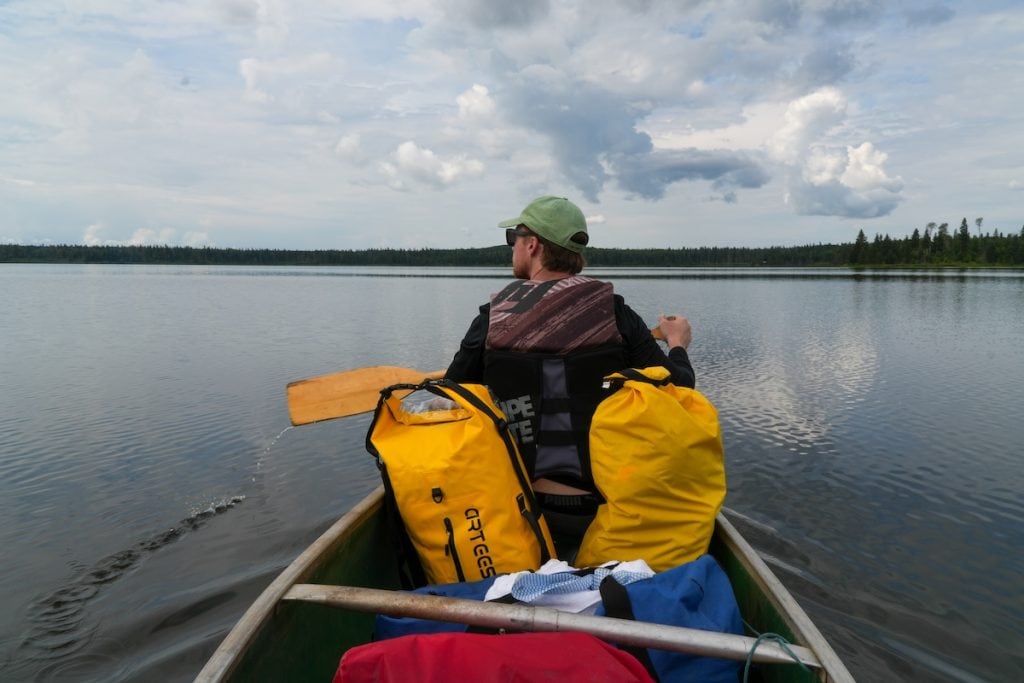
If you’re looking for a backcountry canoe trip in Alberta that offers beautiful lakes, wildlife, remote campsites, and enough adventure to feel like you’ve escaped civilization without requiring a week-long expedition, the Lakeland Provincial Park Canoe Circuit is an excellent choice.
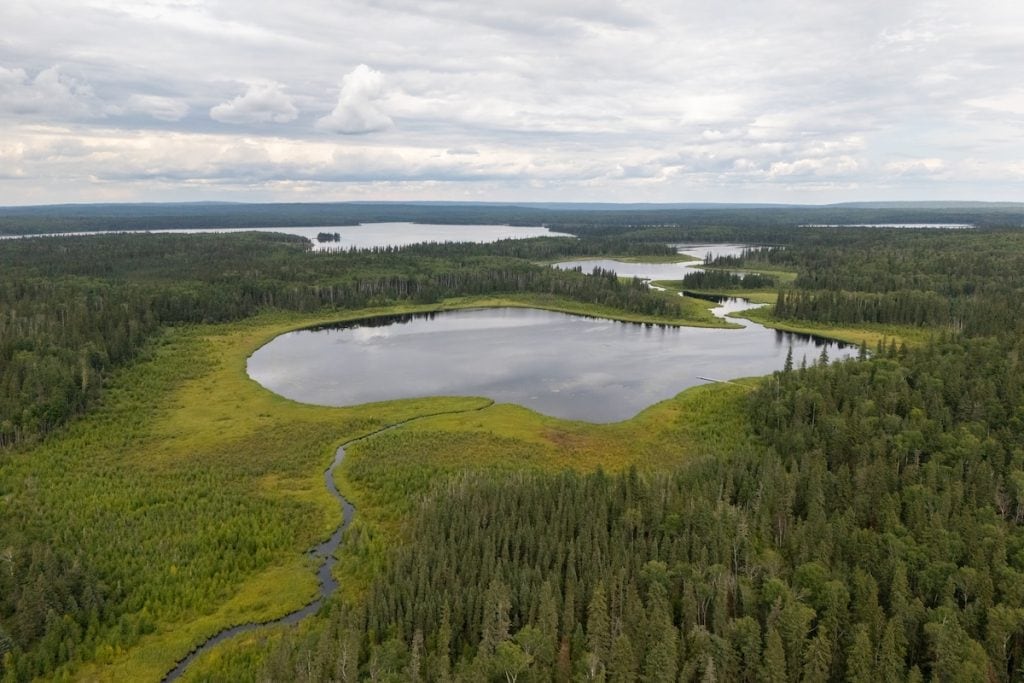
Located near Lac La Biche in northeastern Alberta, Lakeland Provincial Park is home to a network of interconnected lakes surrounded by boreal forest. The park offers several canoe routes and backcountry campsites, allowing paddlers to create everything from short overnight adventures to multi-day wilderness trips.
But don’t mistake “beginner-friendly” for “easy.”
Our first canoe camping trip on the Lakeland Canoe Circuit involved a 3-kilometre hike just to reach the water, muddy and hilly portages, hauling a canoe and gear between lakes, unpredictable weather, and one portage that turned a 1.6-kilometre carry into nearly 5 kilometres of walking because we had to retrieve a canoe cart.
It was also one of the most rewarding outdoor adventures I’ve had in Alberta.
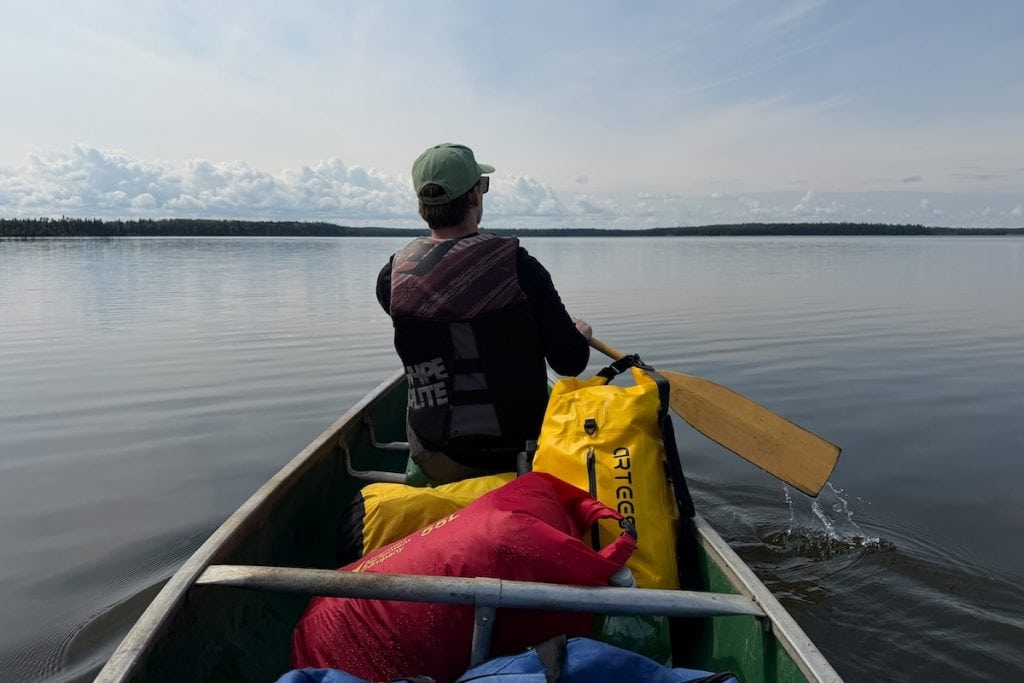
We spent three days paddling across remarkably calm lakes, listening to loons, watching white pelicans, camping on a tiny island, learning about a local Second World War hero, watching the Milky Way and Perseid meteor shower from our campsite, and eventually racing an approaching storm across Jackson Lake.
In this guide, I’ll explain everything you need to know about planning your own Lakeland Provincial Park canoe trip, including how to get there, the route options, portages, campsites, canoe carts, food, water, gear, weather, wildlife, and the lessons we learned along the way.
Lakeland Canoe Circuit at a Glance
| Lakeland Canoe Circuit | What to Expect |
|---|---|
| Location | Lakeland Provincial Park, about 30–35 minutes east of Lac La Biche |
| Route | Jackson → Kinnaird → Blackett → McGuffin → Jackson |
| Distance | 38 km for the main circuit |
| Typical duration | 3 – 4 days |
| Our trip | 3 days / 2 nights |
| Difficulty | Moderate |
| Camping | Backcountry, first-come, first-served |
| Canoe rental | Available in the Lac La Biche area |
| Best for | Paddlers looking for a genuine backcountry experience without a week-long expedition |
| Starting point | Jackson Lake Staging Area |
| Biggest challenge | Portages, especially when carrying a loaded canoe and gear |
| Water | Flatwater paddling, but wind can change conditions quickly |
Alberta Parks calls the 38-km route its main canoe circuit and says it takes approximately three days to complete. The route connects Jackson, Kinnaird, Blackett and McGuffin lakes.
Is the Lakeland Canoe Circuit Worth It?
Yes. If you’re looking for a relatively accessible introduction to backcountry canoe camping in Alberta, the Lakeland Canoe Circuit is one of the province’s best options.
The main circuit covers approximately 38 km, takes about three days, and passes through Jackson, Kinnaird, Blackett and McGuffin lakes. Most paddlers begin at the Jackson Lake Staging Area, then combine flatwater paddling with several portages between the lakes.
How Many Days Do You Need?
We completed the circuit in three days and two nights, camping on Kinnaird Island the first night and McGuffin Lake the second. For a first trip, that worked well, although if we did it again we’d give ourselves three nights to explore more of southern Blackett Lake without creating such a long final day.
The paddling itself was relatively easy in the calm conditions we experienced. The real work came from the portages, particularly when hauling the canoe and camping gear.
If you can spare the extra night, I’d recommend three nights/four days.
| Trip length | Best for | Our take |
|---|---|---|
| 1 night / 2 days | Experienced paddlers or a very quick taste | Possible, but rushed |
| 2 nights / 3 days | First-time canoe campers | Great introduction |
| 3 nights / 4 days | Anyone wanting a more relaxed trip | Our recommendation |
| 4+ nights | Exploring additional lakes and side routes | Great if you want to slow down |
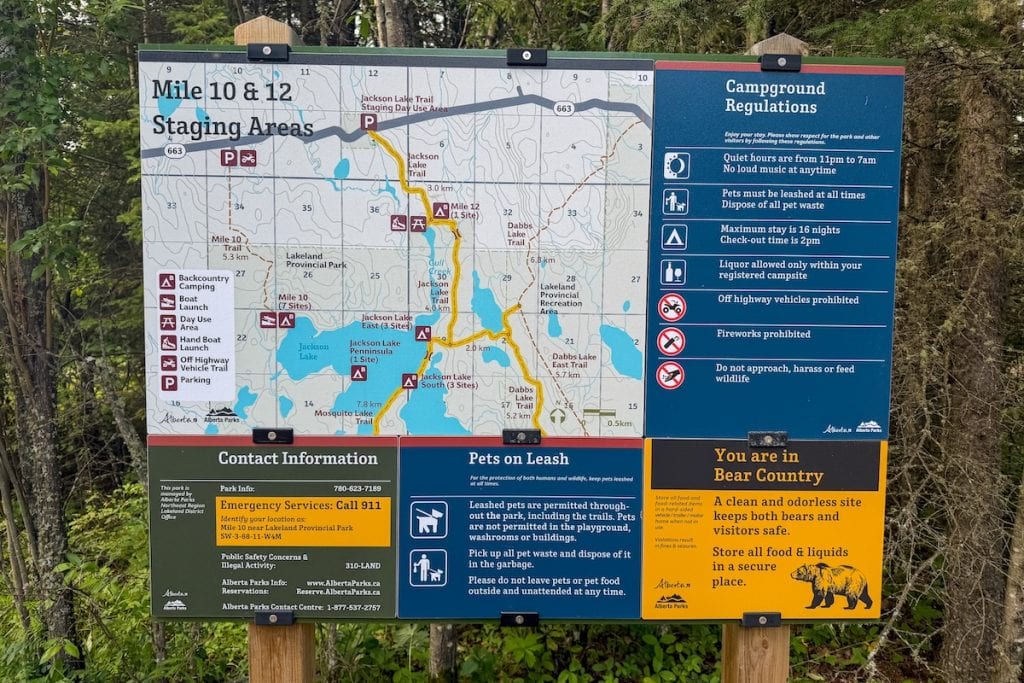
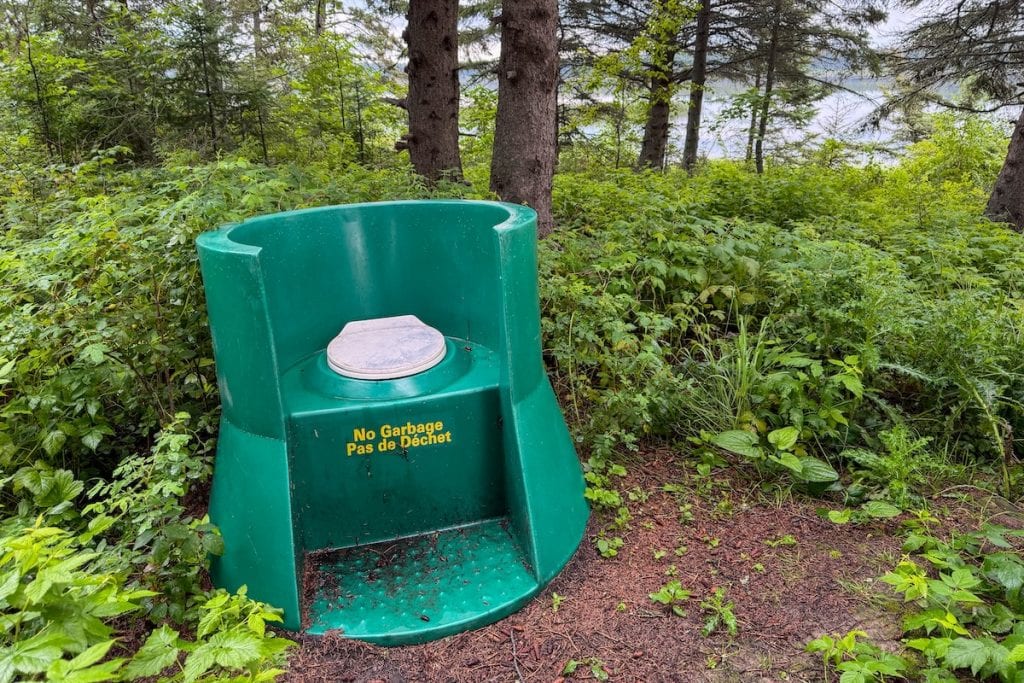
Alberta Parks says backcountry campsites throughout the park are generally equipped with a composting toilet, fire pit, picnic tables and either bear poles or bear lockers, although facilities vary by site. The sites are currently described as first-come, first-served and not reservable. The campsites are free.
And then add your firsthand caveat:
Our experience: Kinnaird Island was one of the highlights of the trip. It’s small enough to explore in a few minutes, but having an island campsite essentially to ourselves made it feel special. McGuffin felt somewhat less remote, but the views and evening sky were fantastic.
That comes directly from your experience and gives the table personality.
Why Go Canoeing in Lakeland Provincial Park?
There are plenty of places to go canoe camping in Canada, but Lakeland Provincial Park offers an appealing combination of wilderness and accessibility.
You don’t need to be an experienced backcountry paddler to enjoy the park, and you don’t need to commit to a week in the wilderness either. The interconnected lakes give you flexibility when planning your route, while designated campsites provide established places to spend the night.
For our first trip, that was exactly what we were looking for.
We wanted a genuine backcountry experience without taking on an enormous expedition. We also wanted to be able to adjust our plans if the weather changed or we realized we’d bitten off more than we could chew.
Lakeland delivered.
During our three days in the park, we saw very few other people. In fact, until the second day, we had encountered only a couple of other canoeists. That made the experience feel genuinely remote, even though we weren’t hundreds of kilometres from civilization.
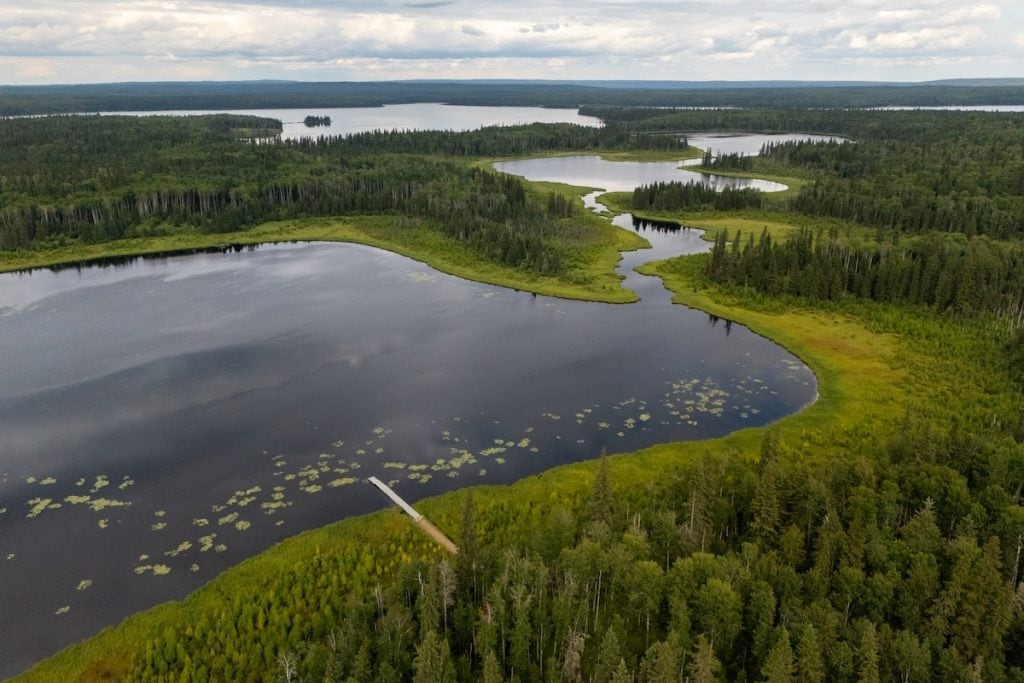
The scenery is quintessential northern Alberta: boreal forest, interconnected lakes, marshes, islands and abundant birdlife.
And if you love loons, you’re going to be very happy here.
Where Is Lakeland Provincial Park?
Lakeland Provincial Park is located near Lac La Biche in northeastern Alberta.
The main access point for the canoe circuit we completed is the Jackson Lake Staging Area, which is reached by a dirt road approximately 35 minutes east of Lac La Biche. The staging area has a large parking area and an outhouse, with signage providing information about the area.
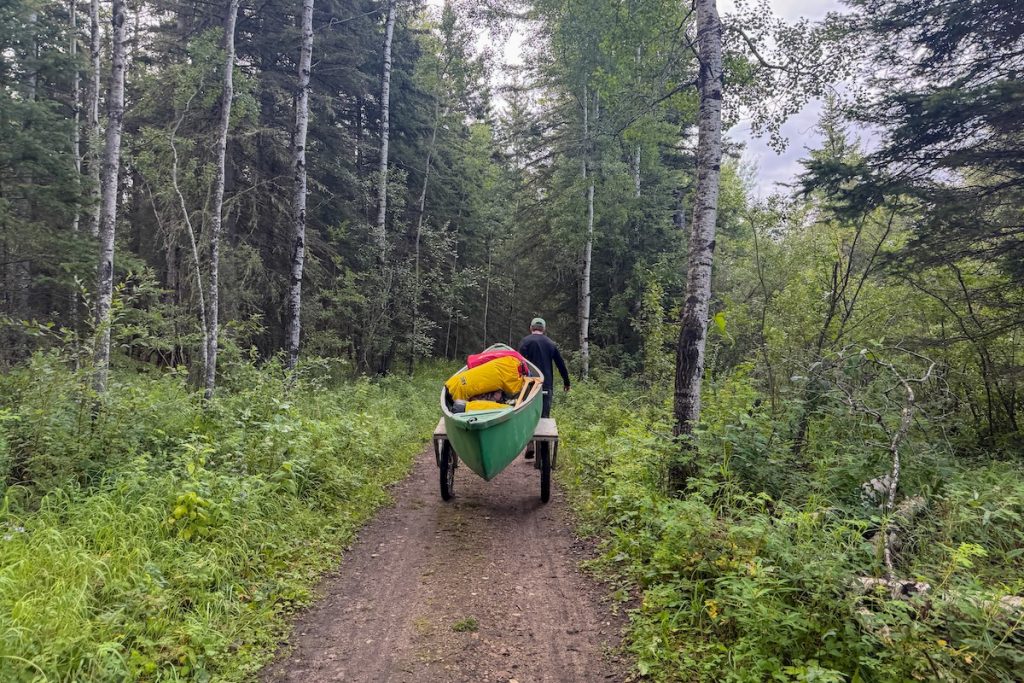
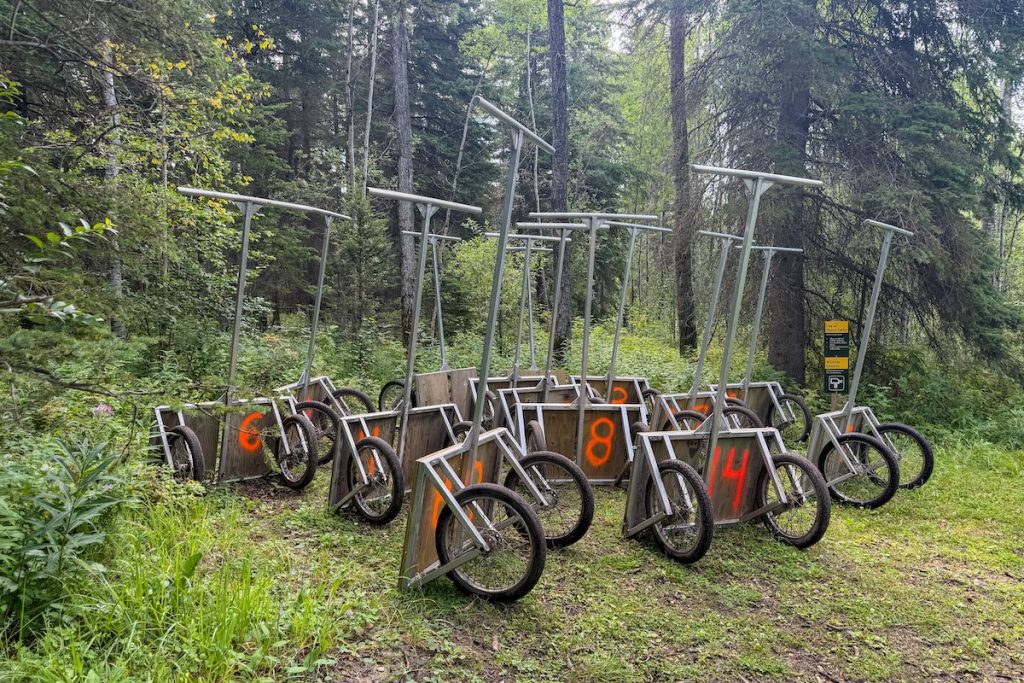
One important thing to understand before arriving is that you don’t simply drive to the edge of the lake and launch your canoe. The canoe route begins with a roughly 3-kilometre hike from the staging area to Jackson Lake.
This is one of the first things I’d want a first-time paddler to know before arriving.
How Difficult Is the Lakeland Canoe Circuit?
I’d describe the Lakeland Canoe Circuit as moderate, with the difficulty depending heavily on which route you choose and how much gear you’re carrying. The paddling itself wasn’t particularly difficult during our trip. We were fortunate to experience remarkably calm water on most of the lakes.
The portages were a different story.
The combination of hills, mud, carrying gear, and hauling a canoe can make relatively short distances feel considerably longer than they look on a map. For a first canoe trip, I’d recommend building more time into your itinerary than you think you’ll need. You don’t want to spend the entire trip watching the clock.
Weather, wind, wildlife, photography stops, swimming, lunch, and simply enjoying the scenery can all add time to your day.
The Initial 3-Kilometre Hike
Don’t overlook this. The 3-kilometre trail from the staging area to Jackson Lake is technically a hike rather than a portage, but because you’re moving your canoe and all your equipment at the beginning of the trip, it feels like one.
It took us a while to get everything organized, and the bugs were particularly bad along this section. Once we reached the lake, however, the effort was immediately worthwhile.
The Lakeland Canoe Route
The route we completed was a three-day, two-night loop beginning at Jackson Lake.
Our general route was:
Jackson Lake → Kinnaird Lake → Blackett Lake → McGuffin Lake → Jackson Lake
We travelled counter-clockwise.
This isn’t necessarily the only way to experience Lakeland Provincial Park, and one of the advantages of the park is that you can customize your trip according to how many nights you have available and how much paddling and portaging you want to do.
For our first trip, two nights worked well, but after experiencing the route, I would seriously consider three nights if doing it again. The extra night would allow more time to explore the southern portion of Blackett Lake and camp on one of the islands without creating such a long final day.
| Campsite | Location | What to know |
|---|---|---|
| Kinnaird Island | Kinnaird Lake | Small island campsite; picnic table, bear locker and pit toilet. |
| Blackett Lake islands | Blackett Lake | Good option if you add a third night and take the southern route, which skips a portage. |
| McGuffin Lake | McGuffin Lake | Larger campsite with bear pole and excellent lake views from the dock. |
Jackson Lake to Kinnaird Lake
After reaching Jackson Lake and launching, we paddled through the narrow inlet before reaching the main body of Jackson Lake. Within minutes of leaving the dock, we were already seeing loons and a beaver lodge. We also had a very unexpected introduction to Lakeland’s surroundings when two military fighter jets flew overhead. Don’t be alarmed if you hear or see military aircraft during your visit. There is an Air Force base nearby, and the occasional aircraft is part of the experience.
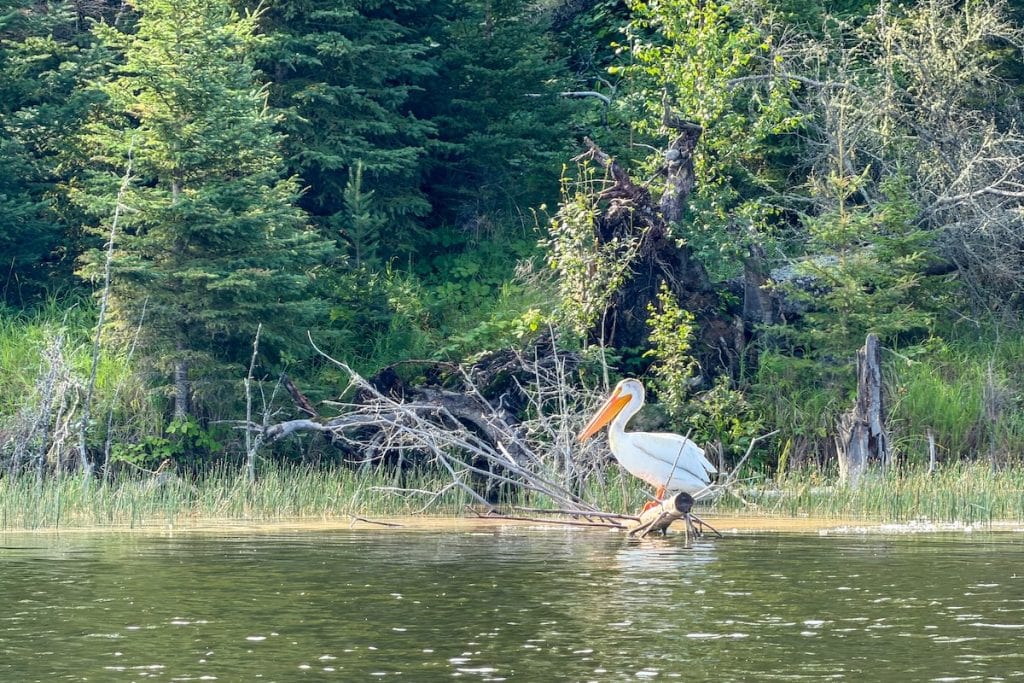
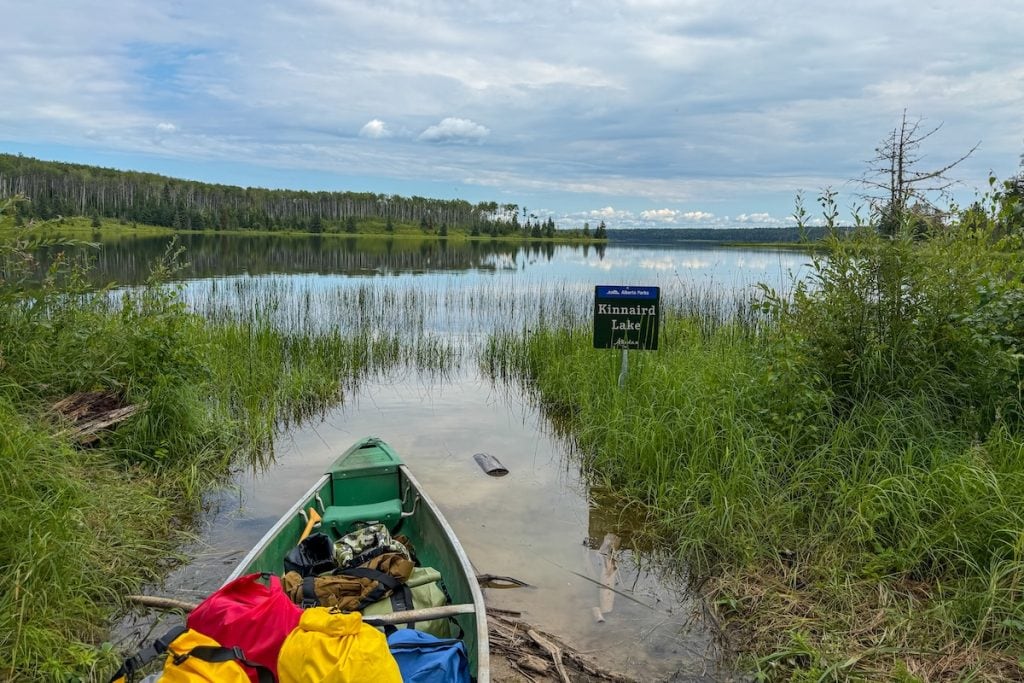
From Jackson Lake, we travelled under a small pedestrian bridge and continued toward Kinnaird Lake. The water was incredibly calm during our trip, often looking almost like glass. This was also when we started appreciating just how much wildlife is in the park. Loons were everywhere, and we also saw large white pelicans.
Kinnaird Island Campsite
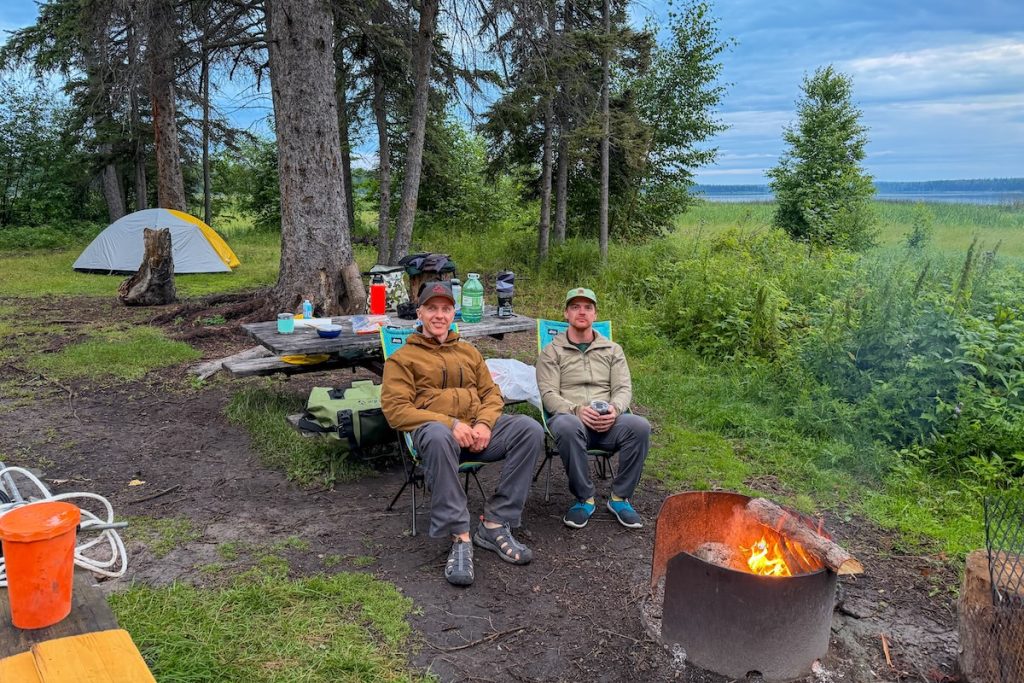
After only a couple of hours of paddling, we reached Kinnaird Island, where we planned to spend our first night. We could have continued farther, but the opportunity to have an entire island campsite to ourselves was too good to pass up.
The island is small—you can explore most of it in just a few minutes—but that’s part of its appeal. Once we landed, we immediately set up camp.
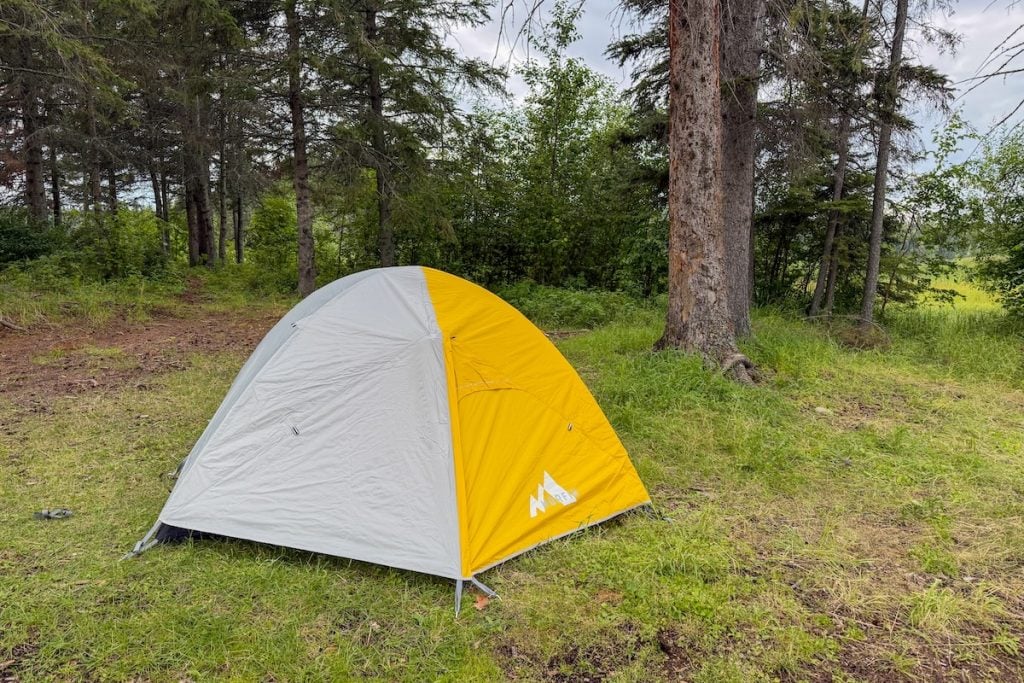
For a backcountry trip, I recommend making your shelter and sleeping system your first priority after arriving at a campsite. Once the tent is up and your sleeping gear is protected, you can relax without worrying about a sudden rain shower ruining your night.
Kinnaird Island also had a picnic table, bear locker and open-air pit toilet, making it considerably more comfortable than you might expect from such a small, remote campsite. We spent the afternoon relaxing, listening to loons and enjoying the island.
Blackett Lake: Which Route Should You Take?
The second day presents an important decision.
From Kinnaird Lake, there are two ways to reach Blackett Lake.
The shorter option involves a roughly 0.8-kilometre portage into the northern portion of Blackett Lake. The map we were using listed the distance as approximately 0.6 kilometres, while the trail sign indicated 0.8 kilometres. Either way, it’s not long, but it is hilly. Plus, canoeing is better than portaging.
The alternative is to paddle farther south and enter Blackett Lake without taking that portage. On paper, the southern route looked incredibly appealing. It would allow us to experience more of the park and avoid the portage altogether.
The problem was time. Because we wanted to spend our second night on McGuffin Lake, taking the southern route would have added several hours of paddling before we’d even reached the longer portage into McGuffin Lake. Since we’d already started the day relatively late, we decided the shorter northern route made more sense.
Looking back, I think we made the right decision.
If I returned for a three-night trip, however, I’d absolutely consider taking the southern route, camping on one of the islands in southern Blackett Lake, and then continuing to McGuffin Lake the following day. That would turn the journey into a much more relaxed exploration rather than trying to squeeze everything into one very long day.
The McGuffin Lake Portage: A Lesson You Should Know
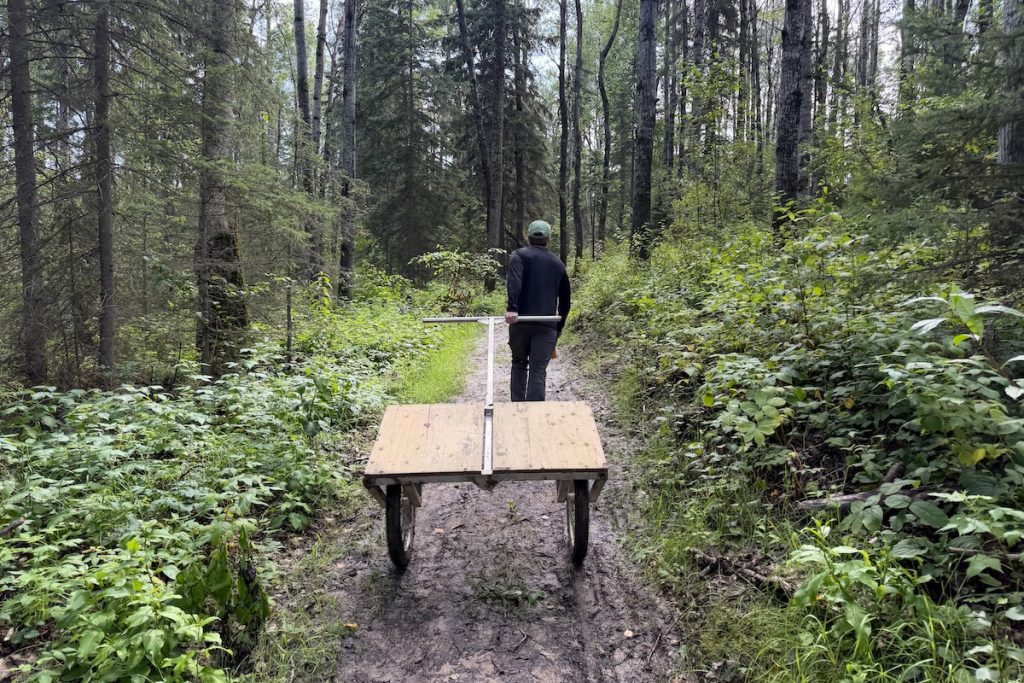
This was probably the biggest practical lesson of our entire trip. The portage into McGuffin Lake is listed at approximately 1.6 kilometres. That sounds manageable.
The problem?
There wasn’t a canoe cart waiting at the beginning of the trail. We had to walk the entire trail to retrieve a cart, walk back to the canoe, load it, and then walk the trail again. Our 1.6-kilometre portage therefore became approximately 4.8 kilometres of walking.
That’s a very different experience.
If you’re planning this route, I’d strongly recommend confirming where canoe carts are located before committing to a particular route and being prepared to carry your canoe if necessary. This was also the first trail where we encountered bear scat. We immediately put the bear spray where it could be accessed quickly and made more noise as we continued along the trail. We never saw a bear, but seeing fresh evidence of one certainly changes the way you walk through the forest.
McGuffin Lake
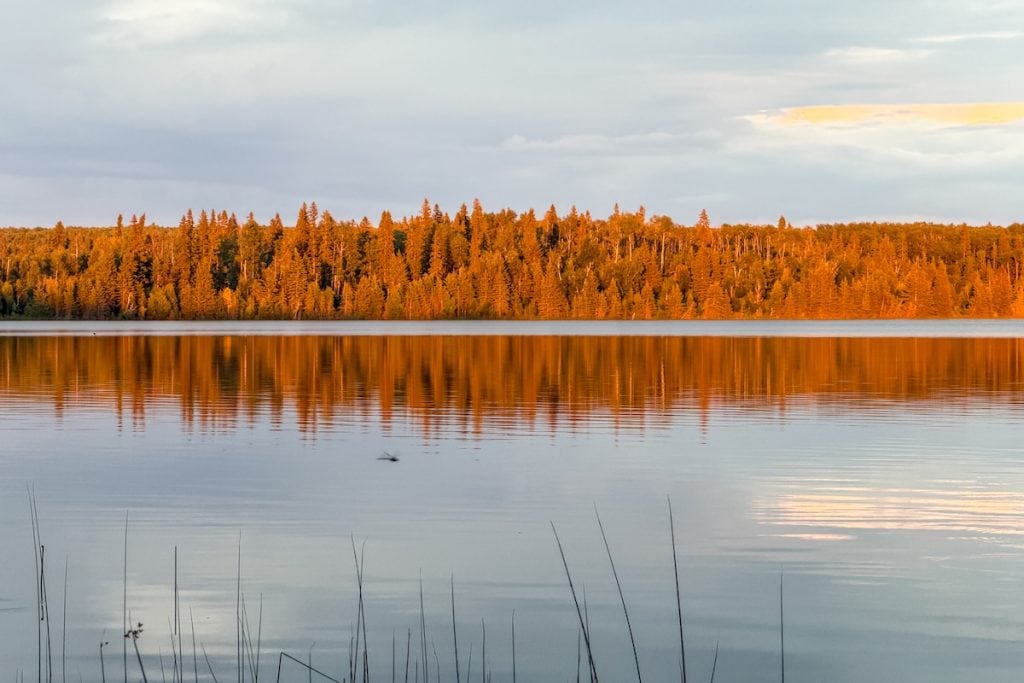
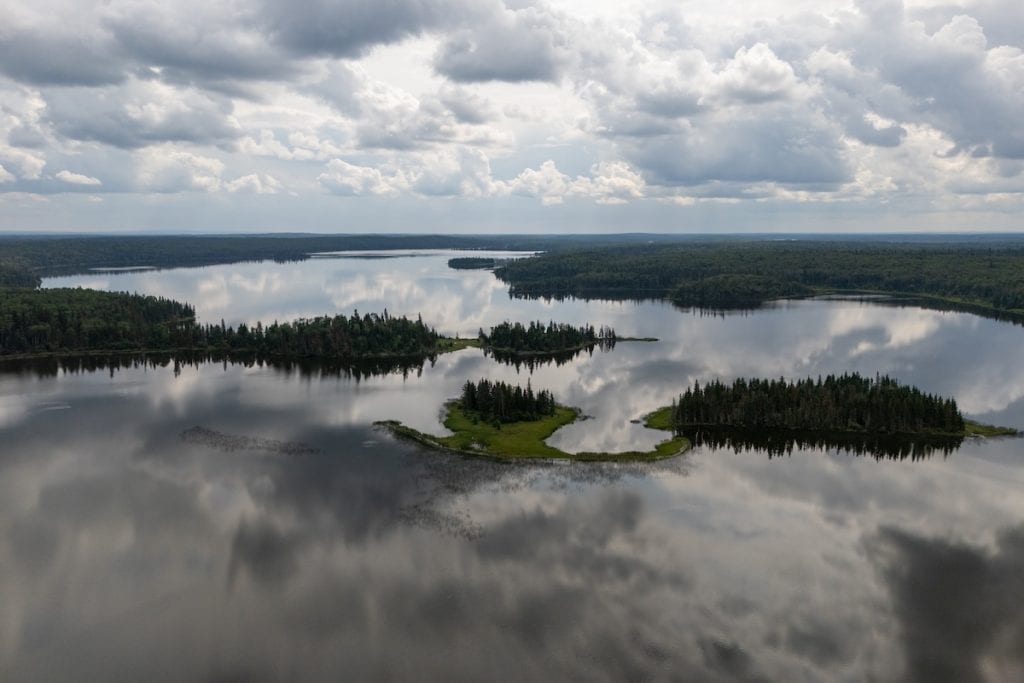
Once we finally reached McGuffin Lake, we were more than ready to get back in the canoe. The dock was another excellent metal structure, and after stretching our legs, we loaded up and began the final paddle toward our campsite. The water was once again incredibly calm, with clouds reflected perfectly across the surface.
We eventually arrived at the McGuffin Lake campground, where we would spend our second night. Unlike Kinnaird Island, this wasn’t a private island campsite. Another camper was already there, and we soon met a man we’ll call Doug, who had been exploring Lakeland Provincial Park for nearly 30 years. He told us he rarely saw people at the campground, which was surprising considering McGuffin Lake has only one campground. The site is also accessible by quad, making it feel slightly less remote than Kinnaird Island. Still, the views from the dock were beautiful.
The McGuffin Memorial
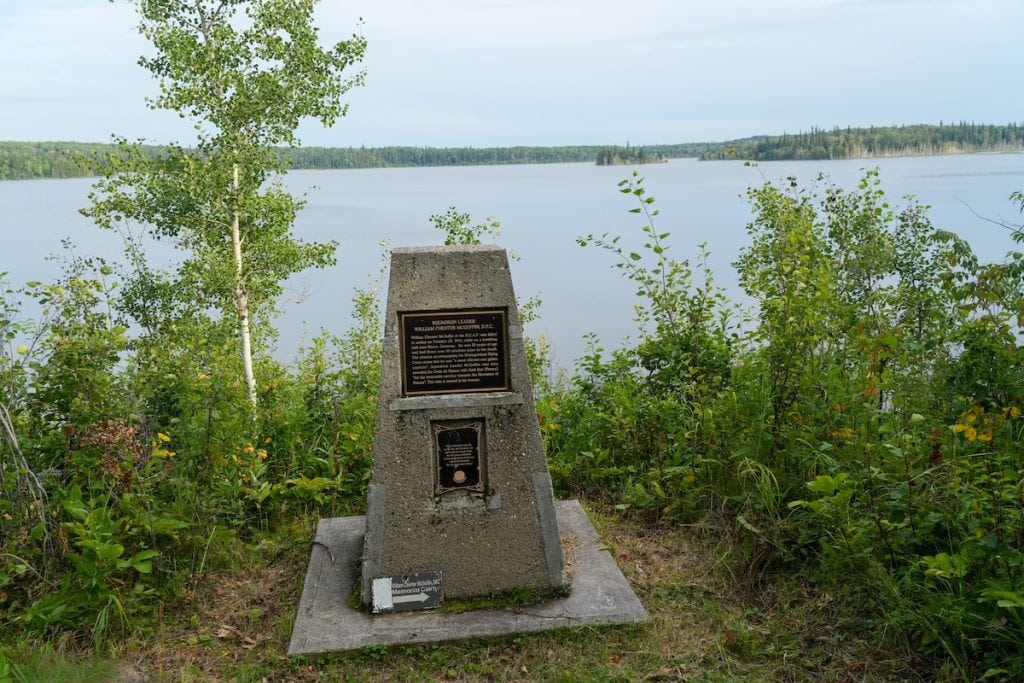
One of the unexpected highlights of our trip had nothing to do with canoeing. While looking at the map, we noticed a symbol indicating a memorial cairn near the campground. A Parks and Wildlife officer who visited the campsite explained that several memorials in the area commemorate local residents who served during the Second World War.
One of them honours William Chester McGuffin, the man after whom McGuffin Lake is named. The memorial is only about 100 metres from the campground along the quad trail, so naturally we went to take a look. The site offered beautiful views over the lake, but the story behind the memorial was even more interesting. McGuffin was killed in action on October 23, 1944, during a bombing raid over Essen, Germany. He was only 29 years old and had already flown more than 50 missions.
The memorial was an unexpected and genuinely moving addition to our canoe trip.
Camping on McGuffin Lake
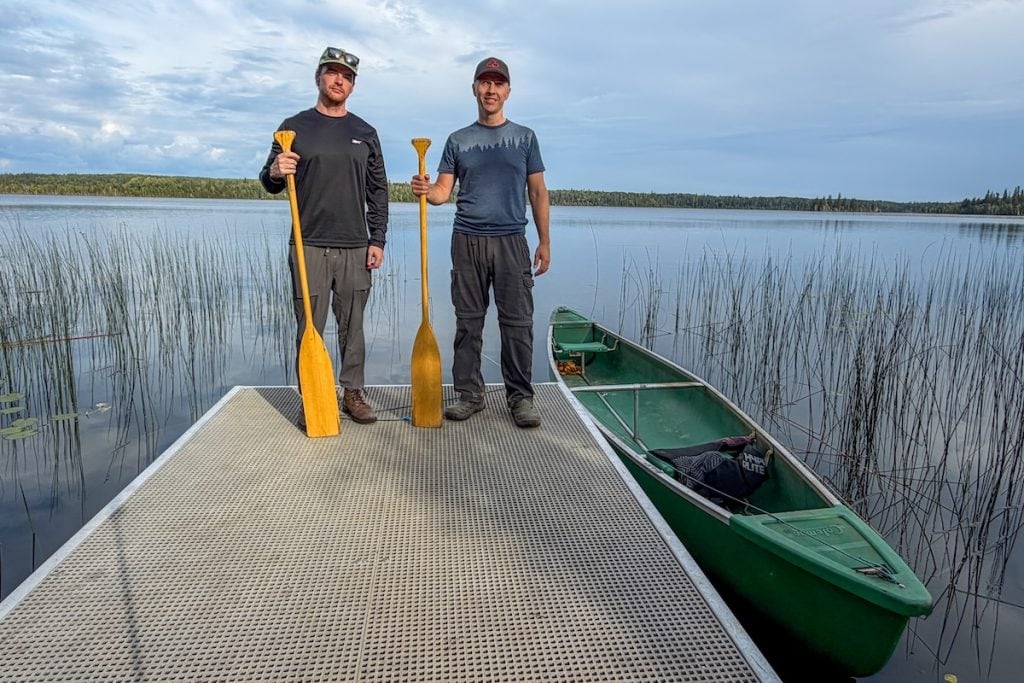
The campsite setup was slightly different from Kinnaird Island. Instead of a bear locker, McGuffin Lake had a bear pole, meaning we needed to hang our food and garbage in a dry bag away from the ground. This is something worth knowing before you arrive because you’ll want rope suitable for hanging your food bag.
After the rain we’d experienced, getting a campfire going was difficult. We hadn’t brought an axe or hatchet, which I would change next time. Thankfully, some of the other campers had larger knives and were able to access drier branches underneath the spruce and pine trees. Eventually, we got a fire going.
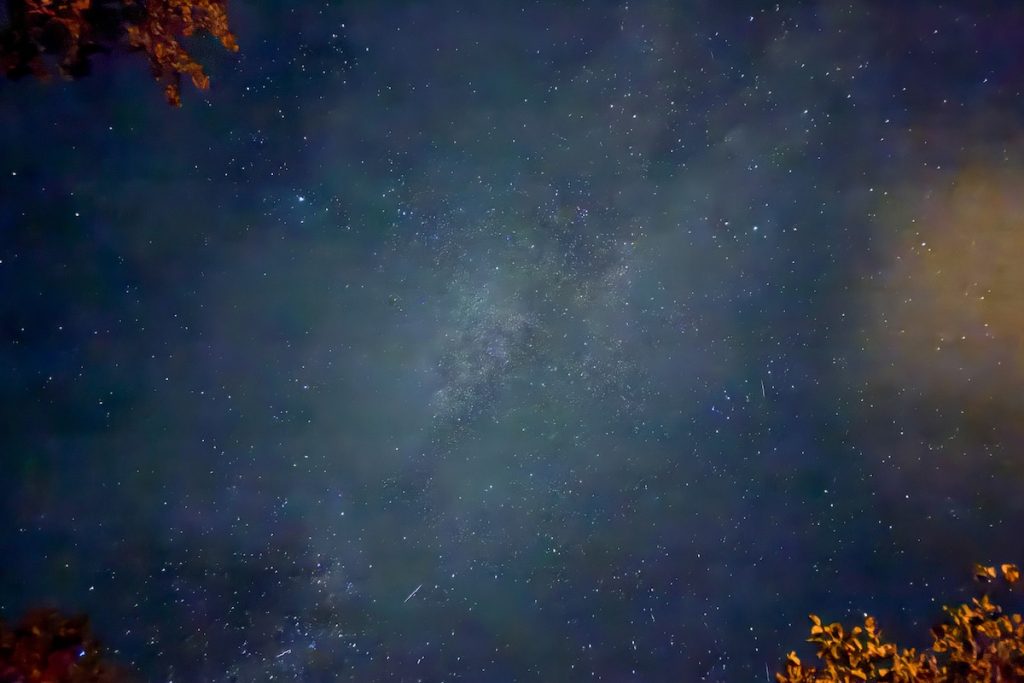
And that turned into one of the best nights of the trip. Once the clouds cleared, the sky opened up. We could see the Milky Way and the Perseid meteor shower, which was particularly active that night. I saw one meteor. My nephew saw several more. Our neighbours, meanwhile, were apparently seeing five or six at a time. We considered staying up longer, but eventually went to bed around midnight. Unfortunately, the clouds rolled back in before we could see any Northern Lights.
The Final Day: Beating the Weather on Jackson Lake
Before going to sleep, our fellow campers warned us that a storm was expected the following day. More importantly, they told us that Jackson Lake can be the most dangerous lake in the park when the wind picks up. Its west-to-east orientation can allow winds to build across the lake, creating challenging conditions for canoeists. An Alberta Parks staff member had given us the same warning when we first arrived.
That convinced us to change our plans.
Rather than enjoying a leisurely breakfast, we woke early, grabbed a protein bar and aimed to be on the water by 8 a.m. That turned out to be an excellent decision. Mornings are often the calmest time on the water, and Jackson Lake was beautifully calm when we reached it. We paddled through a sheltered southern section and a narrow marshy inlet before reaching the open lake.
Once again, we got lucky.
The lake remained calm, and we crossed it without difficulty. But as we approached the northern end, the clouds darkened, and the wind began to pick up. Fortunately, we’d already completed the most exposed portion of the crossing. Once we reached the narrow inlet, conditions became much more manageable. We did get caught in rain during the final 30–60 minutes of paddling, which was actually the first time we’d been on the water during significant rain during the entire trip. Fortunately, we’d packed almost all of our important gear into dry bags.
The Final 3-Kilometre Portage
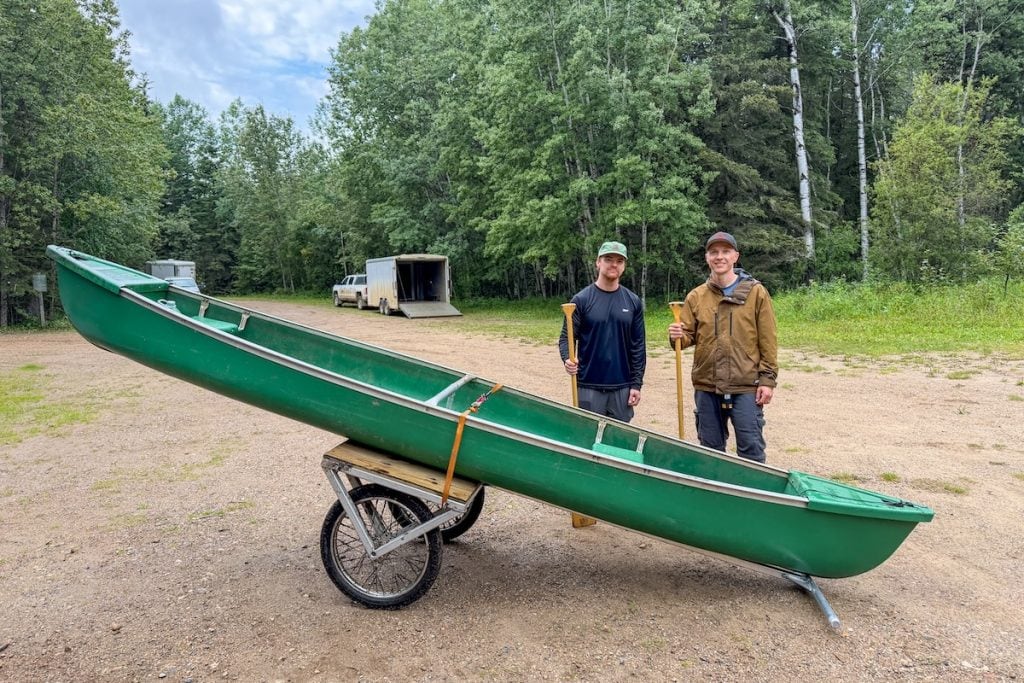
After reaching the dock, we were relieved to see a canoe cart waiting for us.
Without it, our final 3-kilometre hike back to the staging area could have become a 9-kilometre walking exercise, because we’d have needed to retrieve a cart. We loaded everything up, secured the canoe with the ratchet strap we’d learned to appreciate on Day one, and started the final trek back to the vehicle.
This was probably the toughest portage of the trip. The previous rain—and the rain that was still falling—had transformed portions of the trail into thick, ankle-deep mud. Even with two people pulling the cart, it was hard work. Three days of paddling had also caught up with us. My arms and shoulders were feeling it, and every muddy puddle seemed determined to make the final kilometre take longer.
But knowing a hot shower was waiting for us at the hotel provided plenty of motivation. About an hour later, we finally reached the Jackson Lake Staging Area. We unloaded everything, gave each other a ceremonial high-paddle—essentially a high-five using our paddles—and loaded the gear into the car.
We had made it. And yes, that hot shower at the hotel may have been one of the best showers I’ve ever had. The hot tub wasn’t bad either.
Our Recommended Itinerary
Based on our experience, I’d recommend three nights if you have the time. For a shorter first trip, however, our two-night itinerary worked well.
2 Nights / 3 Days
Day 1
- Arrive at Jackson Lake Staging Area
- Load canoe onto cart
- 3 km hike to Jackson Lake
- Paddle through Jackson and into Kinnaird Lake
- Camp at Kinnaird Island
Day 2
- Kinnaird Lake
- Portage into northern Blackett Lake
- Paddle Blackett Lake
- Portage into McGuffin Lake
- Camp at McGuffin Lake
Day 3
- Early departure from McGuffin Lake
- Portage back toward Jackson Lake
- Paddle across Jackson Lake
- 3 km hike back to the staging area
3 Nights / 4 Days
If we were doing it again, I’d strongly consider adding a night.
That would allow you to take the longer southern route through Blackett Lake, potentially camp on one of the islands, and explore more of the southern portion of the park without creating such a long final day.
For a first-time canoe camper, I think the extra night would make the experience considerably more relaxed.
What Should You Bring?
You don’t need expedition-level equipment to enjoy Lakeland. The biggest mistake would be bringing too much. Remember that every piece of gear that goes into your canoe may eventually need to be carried across a portage.
Shelter
- Lightweight tent
- Sleeping bag
- Insulated sleeping pad
- Pillow
Cooking
- Backpacking stove
- Fuel
- Cooking pot
- Spork
- Lighter
- Small sponge
- Small bottle of dish soap
Water
- Drinking water for the beginning of the trip
- Water containers
- Aquatabs or another appropriate water-treatment system
- Coffee filters for removing visible debris before treatment
Clothing
- Quick-drying clothing
- Warm layer
- Rain jacket
- Extra socks
- Completely dry camp clothes
Safety
- First aid kit
- Bear spray
- Headlamp
- Emergency blanket
- Multitool
- Whistle
- Navigation/map
- Phone with offline maps
Waterproofing
- Dry bags
- Garbage bags as additional liners
- Waterproof storage for electronics
Other useful items
- Bug spray
- Sunscreen
- Toilet paper
- Camp chairs
- Rope
- Ratchet strap for the canoe cart
- Small tarp if rain is expected
Costs
Our biggest tip for keeping costs down: If this is your first canoe camping trip, borrow or rent the big-ticket items before investing in a complete setup. You may discover you love canoe camping—or you may discover that three kilometres of muddy portage is your idea of a terrible vacation. However, it’s always worth looking at the costs first. For example, a tent rental would have cost $150 but we ended up buying one on sale for $100.
| Type of trip | Approximate cost | What that assumes |
|---|---|---|
| Budget | $100–$200/person | Borrowed canoe/gear, simple food, camping equipment already available |
| Moderate | $200–$400/person | Canoe rental + existing camping gear + decent food |
| Starting from scratch | $500+ per person | Renting/buying much of your camping equipment |
Food for a Lakeland Canoe Trip
Keep it simple.
You don’t need to prepare gourmet meals when you’re carrying everything yourself. For our trip, breakfasts consisted of instant oatmeal, while dinners were mostly freeze-dried meals. We also brought simple lunches and plenty of snacks. One of the best things we brought was actually something completely unnecessary from a survival perspective: two beers. One for each night.
After a full day of paddling and portaging, sitting in a camp chair beside the fire with a beer while listening to loons was worth the extra weight. And yes, we also brought ingredients for s’mores. Sometimes backcountry camping is about efficiency. Sometimes it’s about marshmallows.
Water Treatment
Although Lakeland’s lakes look clean and inviting, you should treat surface water before drinking it.
For a short trip, purification tablets are an incredibly simple option. They’re lightweight, don’t require batteries, and are easy to pack. A coffee filter can also be useful for removing leaves, insects and larger particles before treatment, but remember that a coffee filter does not purify water. It simply pre-filters visible debris.
Whatever treatment method you choose, follow the manufacturer’s instructions carefully.
Wildlife
Wildlife is one of the biggest reasons to visit Lakeland.
During our trip, we saw:
- Loons
- White pelicans
- Ducks
- Beavers
- Frogs
- Bear scat
We didn’t see an actual bear, but encountering bear scat on a portage was a good reminder that you’re travelling through genuine bear country. Carry bear spray where you can access it quickly rather than buried at the bottom of your pack. Making noise while travelling through the forest is also a sensible precaution.
Is Lakeland Provincial Park Good for Beginners?
Yes—with some preparation.
I’d consider the Lakeland Canoe Circuit a very good introduction to backcountry canoe camping, particularly if you have some basic paddling and camping experience. But don’t confuse it with an effortless weekend at a front-country campground.
You’ll need to:
- Carry a canoe
- Carry your gear
- Navigate portages
- Deal with weather
- Manage food
- Treat drinking water
- Understand bear safety
- Be prepared for muddy trails
The paddling itself can be relatively easy when conditions are calm. The portages are where the work happens. And weather can change the equation quickly.
For us, the biggest factor was wind. Jackson Lake can become challenging when winds pick up, which is why starting early on our final day made such a difference.
5 Things We Wish We’d Known Before Our Lakeland Canoe Trip
1. Bring a ratchet strap for the canoe cart
This might be the simplest piece of advice in the entire article.
A loaded canoe on a cart can become awkward quickly, particularly on muddy or uneven trails. The ratchet strap provided with our rental allowed us to securely attach the canoe to the cart and made the 3-km hike to Jackson Lake much easier.
2. Don’t assume a canoe cart will be waiting at every portage
This was the big one.
The portage into McGuffin Lake is listed at 1.6 km. When we arrived, however, there wasn’t a canoe cart waiting for us. We had to walk to the other end of the trail to retrieve one, walk back to the canoe, load everything, and then walk the entire trail again. Our 1.6-km portage therefore turned into roughly 4.8 km of walking.
Always check current cart availability and be prepared to carry your canoe if necessary. This is a fantastic practical tip for the article.
3. Start early if you’re crossing Jackson Lake
This might be the most important safety lesson we learned. We were warned that Jackson Lake can become challenging when winds pick up. Because a storm was expected on our final day, we decided to get on the water around 8 a.m. The lake was beautifully calm.
Later in the morning, the clouds darkened, and the wind began to pick up. Fortunately, we’d already crossed the most exposed section. Alberta Parks itself warns that weather can change rapidly and that the lakes can become choppy quickly.
4. Give yourself an extra night if you can
Our two-night trip worked.
But if we did it again, we’d probably choose three nights, which would allow us to take the longer southern route through Blackett Lake, potentially camp on one of the islands, and then continue to McGuffin Lake the following day instead of trying to fit everything into one long day.
5. Keep your important gear in dry bags
We got rained on during the final 30–60 minutes of paddling on our last day. But even if rain isn’t in the forecast, you’re paddling on water. Anything that needs to be dry, such as sleeping gear, clothing, food, and electronics, should always be in a dry bag.
Final Thoughts
After spending weeks researching tents, dry bags, water purification, camp stoves and every other piece of gear I thought I might need, I learned that canoe camping isn’t nearly as complicated as I had imagined.
You need good shelter. You need food and water. You need to keep your gear dry. You need to respect the weather and wildlife. And you need to be prepared to carry your canoe through some mud.
Beyond that, the most important thing is simply being willing to slow down. Our three days in Lakeland were filled with calm water, loons, unexpected rain, muddy portages, meteor showers, campfires and more than a few sore muscles.
Would I do it again?
Absolutely.
In fact, I’d love to go again, but as I mentioned before, I’d make it three nights so I could explore the Southern part of Blackett Lake and camp on more islands.
This might be Alberta’s only canoe circuit, but it’s easily one for the Alberta bucket list.